
Case
Decision Under Fire: Applied Strategy in a Conflict Zone
How a crisis decision framework was built in a day, tested under missile attack the same night, and why it reads Level B while the world celebrates a ceasefire.
The Problem: Deciding in a Conflict Zone #
In a conflict zone, the hardest decision is not what to do when the bombs fall. It is to determine when staying is no longer tenable. Everyone who lived or worked in the Gulf during the 2026 conflict wrestled with this question. Most arrived at an answer at the worst possible moment: when pressure was highest, information least reliable, and emotion strongest. The problem is not deciding under pressure. The problem is deciding for the first time under pressure.
Existing instruments do not solve this. Government advisories are static: the Netherlands held the UAE at “orange” for 40 days, from day 1 through the ceasefire. Corporate risk advisory delivers information without thresholds: "elevated risk, monitor closely" does not tell you when to act. The most common alternative is nothing: improvise on feeling, rumour, or the behaviour of neighbours. The gap is not information. It is that the analytical preparation is missing. Without a structure that tests predefined criteria against current evidence, the decision-maker decides blank, under maximum pressure.
Why a Framework Solves the Dilemma #
On a calm day, establish your boundaries. Define what evidence justifies what action. Set thresholds. Document them. When the crisis peaks, you do not decide for the first time. You verify whether the conditions you defined earlier have been met. The framework does not replace the decision-maker. It gives him a structured proposal, built on his own criteria, tested against current evidence, at the moment he needs it most. Schelling described the logic in The Strategy of Conflict (1960): commit to conditions when you think clearly, so that under pressure you only verify.
What an Escalation Framework Looks Like #
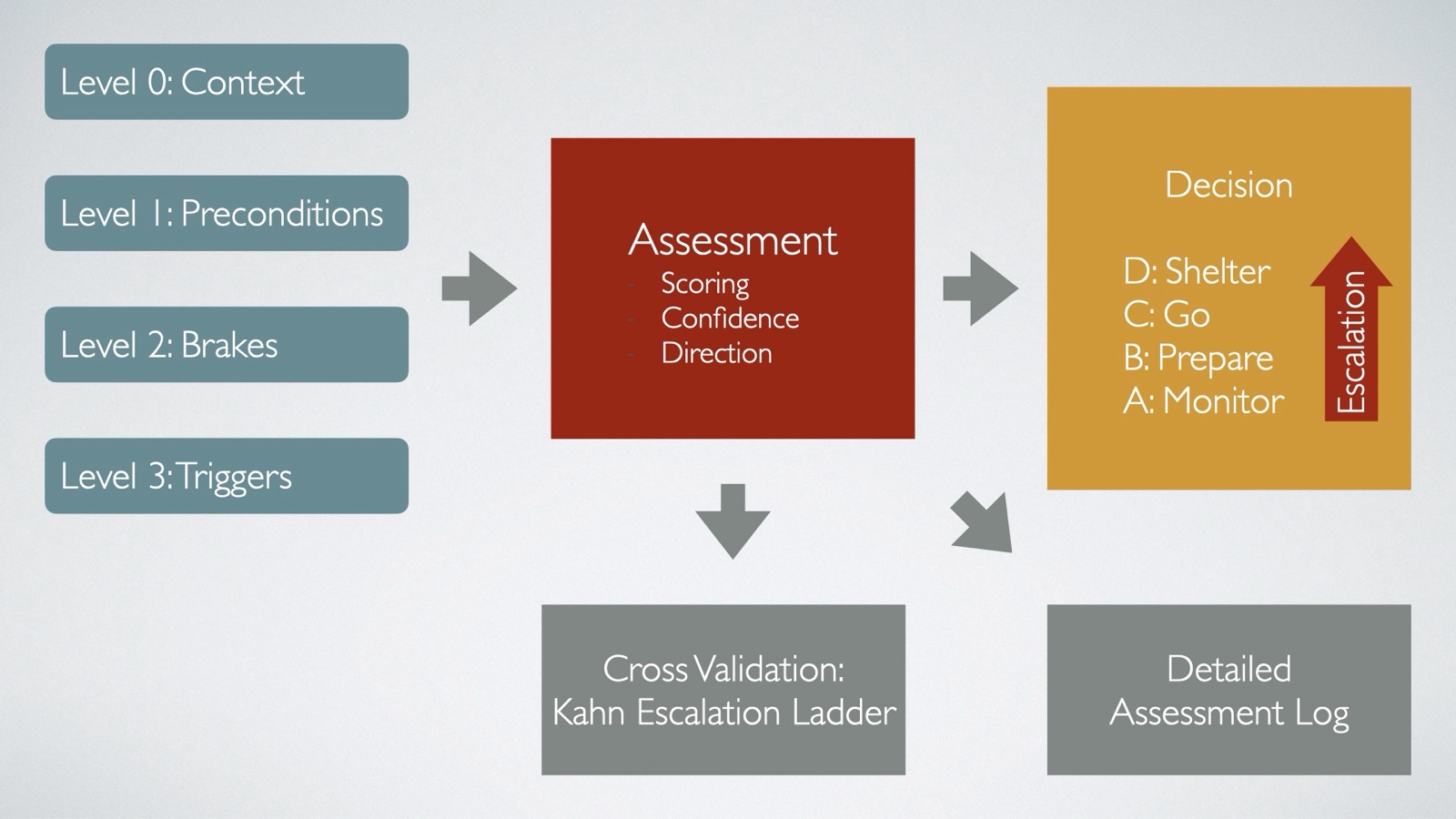
Leaving has a price, and the price is not constant. Under bombardment, departure is defensible. Under a ceasefire, when peers stay and the professional environment normalises, the reputational cost of leaving rises precisely when the physical cost of staying falls. A usable framework starts here: it integrates exit costs as its foundation (Layer 0), raising the evidentiary threshold for discretionary departure but never overriding a hard trigger.
Escalation does not come from nowhere. It requires conditions that must already be present before the red line enters the decision space: a conventional impasse, a closed political exit, a collapsed deal structure. These are slow-moving and structural. They change over days or weeks. In the framework, they form Layer 1: the preconditions. When fulfilled, the situation is primed. When not, dramatic rhetoric remains rhetoric.
Escalation does not proceed automatically. It is interrupted by institutions: a parliament that constrains, a military chain of command that resists, diplomatic channels that transmit proposals, allies that press for restraint. These are the brakes (Layer 2), scored as OK, Degraded, or Failed. This layer carries the framework's central logic. In a genuinely novel situation, the available data carries insufficient information about the catastrophic event itself. The framework therefore does not attempt to predict it. It measures the exhaustion of the mechanisms that prevent it. When brakes fail one by one, the window closes.
Then there are the fast signals: rhetoric shifting from conventional to nuclear, attacks on nuclear facilities, evacuation orders, patterns that break. These are Layer 3: the triggers that offer the least reaction time.
The layers feed into four action levels (Monitor, Prepare, Go, Shelter), each with explicit evidence tests. Three mechanisms make the framework operational. Confidence scoring ensures fragile evidence does not carry the same weight as confirmed evidence. Directional scoring captures not just position but trajectory: "Level B, rising" is a fundamentally different situation from "Level B, falling." Pre-identified triggers close each assessment with named signals that would change the level next. In the moment, you do not deliberate. You check the list.
A reference test validates the output. In this application, Kahn's escalation ladder (On Escalation, 1965) was used: a classification of conflict stages from diplomatic tension to nuclear war. The comparison prevents normalisation (you see the trajectory across days, not just the point), forces forward thinking (what takes us to the next rung?), and provides a sanity check: if the framework reads Level B but Kahn reads rung 21, something is wrong.
Bias protection is built in: normalisation bias, panic bias, narrative bias, and the bias most dangerous after a ceasefire: confusing relief with evidence.
The Application #
The dilemma
Abu Dhabi, April 2026. A professional and his partner, who holds a senior position in Abu Dhabi's financial sector, during a war that could acquire a nuclear dimension. The red line: nuclear escalation. But once crossed, evacuation routes close. Leave too early and you damage a career whose value is substantial. Leave too late and the question is moot. The framework was built in a single day to structure this trade-off.
The framework in practice
By day 39, all five Layer 1 preconditions were fulfilled. All four Layer 2 brakes were Degraded or Failed; zero OK. Layer 3 registered nuclear-adjacent rhetoric at its most extreme form, active insider warning signals, and the Bushehr nuclear facility at Pre-Trigger status after a strike 75 metres from the reactor perimeter. Kahn placed the conflict at rung 17, rising. The framework read Level B, upper boundary, rising.
The night it was tested
Three clocks ran simultaneously that night. The political clock: deadlines, ceasefire talks, breakthroughs. The military clock: kill chains, missile launches, infrastructure strikes. The analytical clock: the framework's assessments and pre-identified triggers. The framework forces separation when the world collapses them.
16:30 GST, 7 April. First assessment. Level B, mid-range. The framework was hours old and immediately produced a structured baseline where there had been none.
22:00 GST. Five escalations in 5.5 hours. Kharg Island struck again. Iran walked out of talks. Oil restraint lifted. Israeli infrastructure strikes executed. Trump: "a whole civilisation will die tonight." Level B, upper boundary, rising. Pre-identified triggers for C named: full infrastructure campaign, explicit nuclear rhetoric, confirmed Bushehr damage. Those triggers were determined now, while thinking was clear. At 03:00 they would be the only things that mattered.
02:00 GST, 8 April. Ceasefire announced. The political clock stopped. The military clock did not.
03:31 GST. Every phone screen: "Potential missile threats. Seek shelter immediately." A ballistic missile struck Sharjah. Ninety minutes after the ceasefire. No deliberation needed. The pre-identified triggers for C were checked: none met. Level B held. The 90-minute gap between political decision and impact revealed Iran's kill chain after 39 days of bombardment. That datapoint comes from applying the framework while the missile struck. No remote analyst can produce it.
10:00 GST. First downward movement in 72 hours. B, mid-range, falling. The framework registered improvement without surrendering to relief.
16:00 GST. Back up. 17 ballistic missiles and 35 drones intercepted. Debris caused fires at the Habshan gas complex. Fourteen hours after the ceasefire. The political clock said peace. The military clock said 17 missiles. Level B, upper boundary. The 48-hour test could not start.
Conclusion #
The framework is running now. The ceasefire may hold on the bilateral axis and fail on the Gulf axis. The framework will measure the difference: not hope against fear, but evidence against predefined tests.
AI can execute the daily assessments. AI cannot design the framework. The design requires strategic experience, escalation theory, and the willingness to determine in advance what evidence justifies what consequence. That is architecture, not analysis. The principles are transferable. A different company, a different region, a different type of crisis. The same discipline.
The full Escalation Risk Assessment Framework v7.0 and the complete assessment log from this conflict are published as a live case reference at outdoorconnect.ae.
The missile at 03:31 struck a building in Sharjah. Debris at Habshan struck Abu Dhabi's largest gas processing facility fourteen hours after the ceasefire. The framework prevented neither. It prevented the wrong conclusion afterwards.
A ceasefire that does not stop the missiles is not a ceasefire. It is a press release. The framework does not score press releases. It scores missiles. That is what strategy does when it is applied.
Analytical Foundations #
Herman Kahn, On Escalation (1965). Escalation ladder as positioning and reference discipline.
Thomas Schelling, The Strategy of Conflict (1960) and Arms and Influence (1966). Prior commitment, focal points, face-saving exits.
Robert Pape. Escalation stages and compellence theory.
Cramér-Rao lower bound and Fisher information. The information limits of strategic inference under genuine novelty.
Outdoor Connect, US–Iran Escalation Risk Monitor (April 2026). Framework documentation, assessment log, and downloadable reports: outdoorconnect.ae/us-iran-escalation-risk-monitor.
Cite this piece
Schotman, R. (2026). Decision Under Fire: Applied Strategy in a Conflict Zone. Outdoor Connect. https://outdoorconnect.ae/library/decision-under-fire/
© Outdoor Connect 2026. All rights reserved. Quote with attribution. Use and attribution