Essay
The Price of Presence
The UAE property market is priced on people, not buildings. Why valuations rest on a continuous inflow of residents, and what happens when that assumption breaks.

Library
Essays, frameworks and cases on strategy, freedom of action and strategic leadership, ordered by framework, series and theme.
Instrument: Strength, unique asset or control point? →
Nine essays and a companion, written from Abu Dhabi in March 2026, on the US–Iran war: a conflict that was structurally misread. Start here for the argument that runs through the series.
Essay
The UAE property market is priced on people, not buildings. Why valuations rest on a continuous inflow of residents, and what happens when that assumption breaks.
Essay
Capital is abundant in the Gulf. Focus is not. Why capital has lost its role as a strategic filter in the UAE, and how abundance breeds pilot inflation and diluted attention.
Essay
A routine water delivery in Abu Dhabi reveals something structural: bottled water is not about water but about confidence, and that confidence may be migrating into infrastructure.
Essay
A board memorandum for companies in the UAE: this is not a downturn but a breakdown in the basis for decisions. Which signals can still be trusted enough to act on?
Essay
The economic cost of the Gulf conflict is behavioural, not physical. How threat, mobility and time turn uncertainty into a lasting erosion of the UAE economic model.
Case
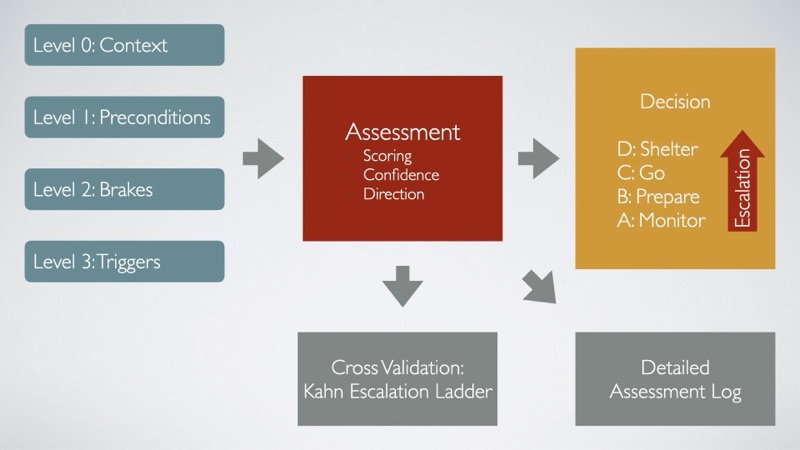
Stay or go cannot be decided well under fire. How a crisis decision framework with predefined thresholds was built in a day and tested under missile attack the same night.
Decision framework
When does staying stop being rational? A monitor with explicit thresholds for deciding under escalation, because official advice offers stability and risk advisory offers information, but neither offers timing.
Essay
More data and more powerful AI will not deliver certainty. Drawing on information theory, why the real risk is failing to recognise when knowing ends, and why judgement must carry the decision.
Essay
Organisations do not lack data; they lack thinking. How the illusion of precision, digital comfort and the loss of dissent undermine decisions, and what leaders can do to restore strategic clarity.
Essay
Revisiting Nicholas Carr for the age of AI: AI has crossed from advantage to infrastructure, so differentiation now lies in how leaders use it to amplify what only they control.
Essay
AI may advise, but who still signs? The decisions boards must never delegate to machines, and how AI can quietly erode the purpose of a company while claiming efficiency.
Essay
Price reveals conviction, not just cost. How transparency and uniformity shape competition, from Barolo to Apple, and why companies compete on what they stand for rather than what they sell.
Essay
Behaviour changes before data does. By the time instruments confirm a systemic shock, the decisions that matter have closed. The operating logic for boards that cannot afford to wait.
Essay
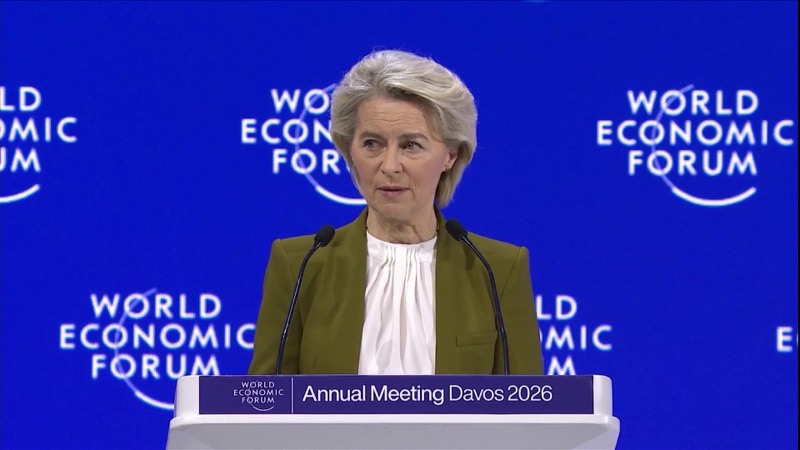
Building on Ursula von der Leyen's Davos 2026 speech: why dependency is giving way to conditional partnership, and what that demands from Europe, boards and executives.
Essay
Power can be delegated and permission formalised. Conscience cannot. An essay, begun under a missile alert in Abu Dhabi, on what an organisation can and cannot grant a leader.
Essay
The Netherlands is managing decline instead of designing advantage. How public capital now preserves legacy industries, eroding productivity and direction, and how leadership can still restore long-term strength.
Essay
Europe is not behind; it is misjudged. It built power through indispensable positions in global ecosystems rather than platform dominance, a capability suited to fragmented, real-world markets.
Essay
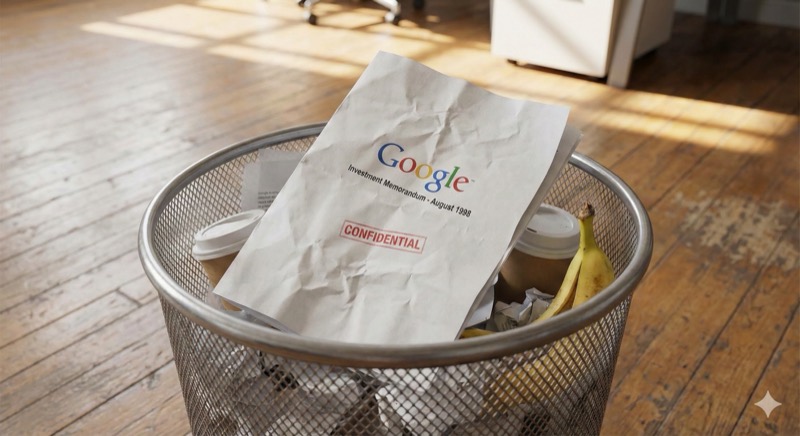
Saying no feels safe, yet it is how the biggest opportunities are lost. How rational refusals become strategic disasters, and how leaders keep the future out of their own anti-portfolio.
Essay
Everything works. Nothing moves. The greatest risk for the Netherlands is not collapse but comfort, and the country needs a deliberate strategic shock to recover its sense of direction.
Essay · In Dutch
Ruim twee miljard euro om Tata Steel IJmuiden te vergroenen, gepresenteerd als strategie maar geworteld in ontkenning. Waarom de subsidie kapitaal vastzet in het verleden in plaats van te investeren in de toekomst.
Essay · In Dutch
Een staat die de controle over zijn digitale identiteitslaag verliest, verliest geleidelijk de controle over zichzelf. Waarom DigiD onder buitenlandse jurisdictie geen technisch detail is, maar een strategisch risico.
Essay
Advantage does not come from eliminating friction, but from shaping it: low resistance where movement is needed, high resistance where control is required.
Essay
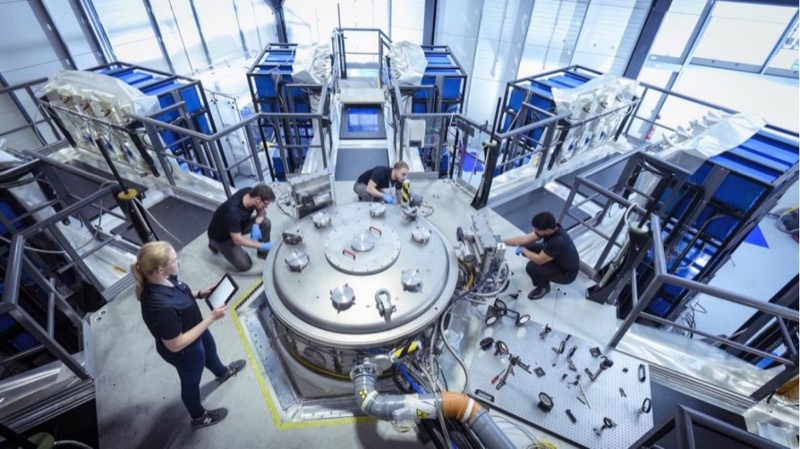
Fusion is usually treated as a science project. This paper treats it as a product with a unit, a cost curve and a control point, and explains why First Light Fusion takes a different path.
Essay
Our 2012 white paper on ISVs in the cloud, reassessed in 2025. The economic logic still holds, but geopolitics, data sovereignty and ecosystem control points now decide who succeeds.
The Agentic Home · Part 1 of 2
From connected to intelligent living: the Agentic Home as a virtual butler that anticipates and orchestrates daily life, and why it redefines the long-term value of luxury real estate.
The Agentic Home · Part 2 of 2
When homes start to reason. The architecture behind the Agentic Home, from rules to probabilistic intelligence and multi-agent design, and what it means for governance and value creation.
Essay
What the most extreme vineyards teach about advantage: constraints create clarity, trade-offs define position, and real strength comes from changing the rules rather than playing harder within them.
Case
Carmec, a technology-driven automotive data company, had strong assets and little traction. How its board moved from parallel initiatives to a deliberate choice of what to win at first.
Case
A personal story of how a senior club championship was won not through experience but by redefining the game. In sport as in strategy: shape the game to your strengths.
Case · In Dutch
Je hoeft niet groter te zijn om sterker te staan. Wat Sinterklaas begrijpt over aandacht, ritueel en beloften die worden waargemaakt, en waarom dat mid-market bedrijven meer macht geeft dan schaal.
Case · In Dutch
Sinterklaas is van niemand en daardoor van iedereen. Wat een open source-ritueel onthult over control points, macht en gedeeld eigenaarschap, en waarom dat in jouw markt anders werkt.
Essay
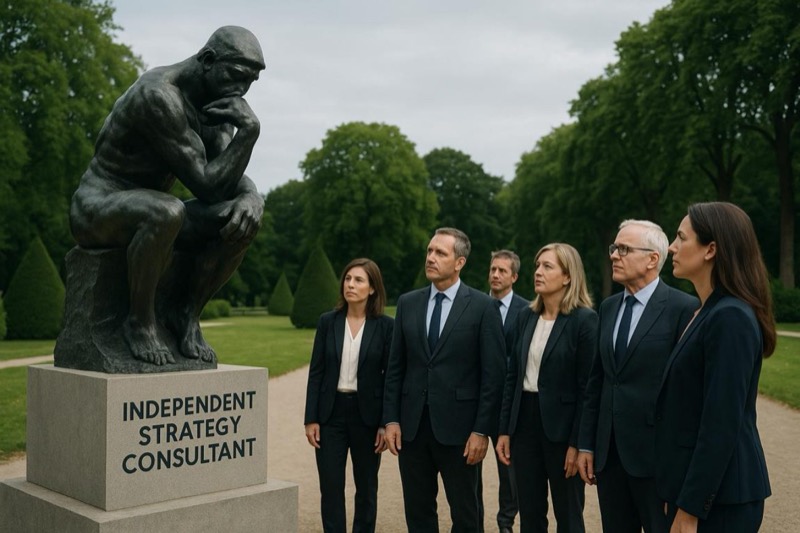
Mid-sized firms are too complex to go without strategy and too small for sustained top-tier attention. Why independent, senior advice fills that structural gap, and why its scarcity is its value.