
The 2026 Iran-War Series · Part 6 of 9
The Last Meeting
What if the target designed the strike?
Nine months before the strikes, in June 2025, satellite imagery captured convoys of trucks at Iran’s Fordow nuclear facility. Four hundred kilograms of highly enriched uranium was moved. By 28 February 2026, its location was unknown to the IAEA, to the United States, and possibly to all but a handful of individuals inside Iran itself.
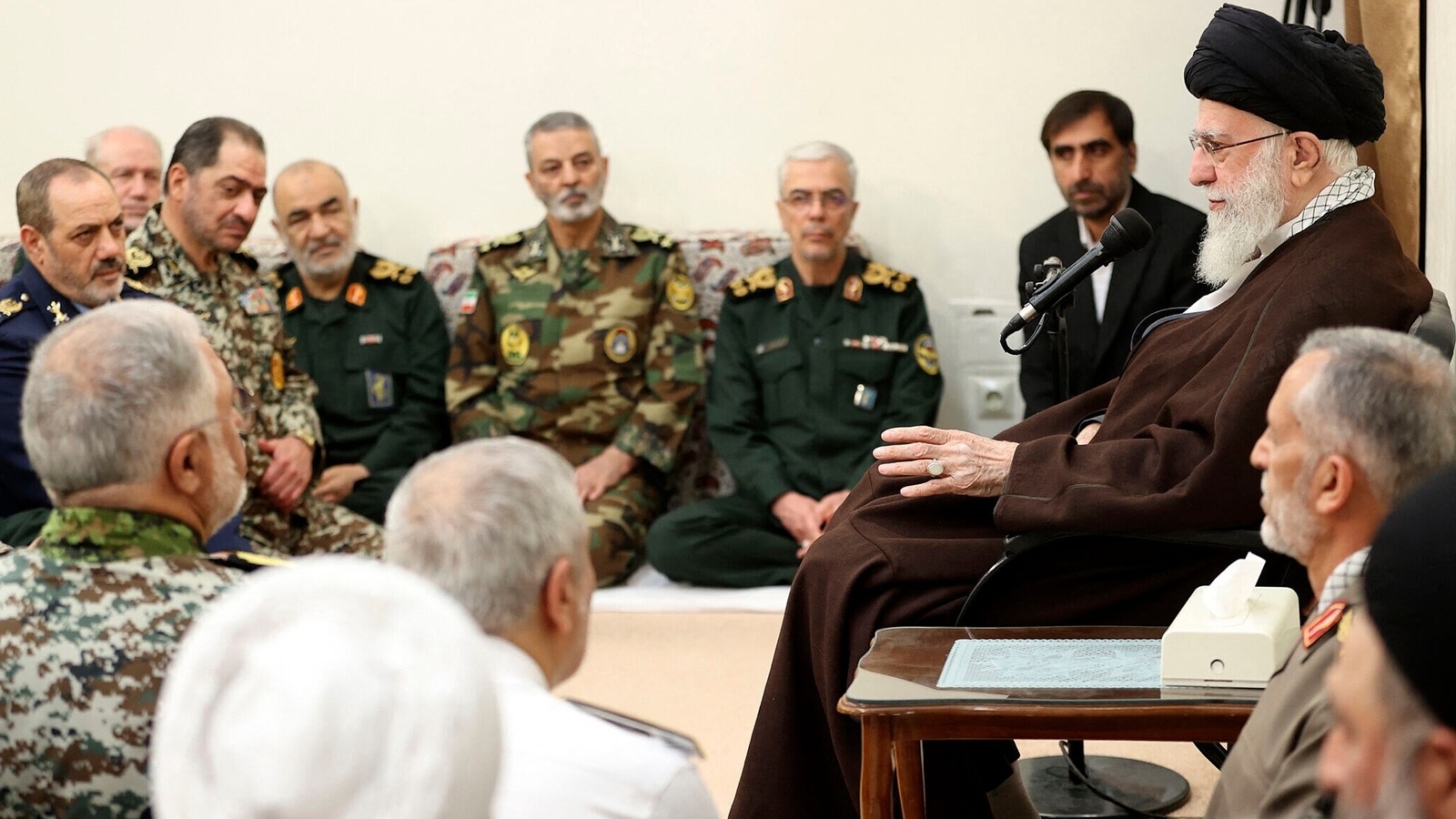
On the morning of the attack, Iran's full senior leadership assembled at a known location.
Iran moved what it needed for its nuclear future. It did not move its political leadership.
This is the fact that every conventional explanation of the strike must account for. A system that had the operational awareness to secure its most sensitive nuclear material months before the attack did not disperse the people who run the country. The same apparatus that organised a convoy of trucks to an undisclosed location did not organise a change of venue for its supreme leader.
The conventional reading is incompetence, or perhaps fatalism, or perhaps an intelligence failure inside a system that was otherwise preparing for war. Each of these explanations requires you to believe that Iran's security establishment was simultaneously competent enough to protect its uranium and incompetent enough to expose its entire leadership. That is not a coherent position.
This essay proposes a different reading.
Ali Khamenei knew the strike was coming. He chose to be there. And the meeting itself may have been designed to ensure the strike would happen.
This is a radical claim. It requires careful examination. The argument that follows is presented in three layers. The first rests on observable evidence. The second applies an analytical framework. The third follows the logic to its full conclusion. Each layer is independently defensible. Each makes the next more plausible. The reader decides how far to go.
What the Evidence Shows #
The selective protection of the uranium is the first anomaly. It is not the only one.
In the hours before the attack, the author of this essay, sitting in Abu Dhabi with access to nothing more than publicly available information and a commercial AI tool, concluded that a strike was imminent. The pattern was legible: the acceleration of rhetoric, the positioning of assets, the narrowing of diplomatic space. No classified intelligence was required. No satellite network. No signals intercept. A browser and the ability to read a sequence of events were sufficient.
The AI tool itself did not reach the same conclusion. When asked directly, it assessed the probability of imminent military action as low, citing ongoing diplomatic signals and the absence of confirmed mobilisation indicators. It processed more data, faster, with more computational power, and arrived at the wrong answer.
The previous essay in this series explained why. Inference systems are bounded by the information their data contains about the variables they are trying to estimate. When the data carries no information about intention, more data does not help. The AI measured signals. It could not measure the decision behind them.
But this observation has a corollary that is more consequential than the original argument.
If a single individual with public data could see what was coming, Iran’s own intelligence apparatus, with decades of experience reading American and Israeli behaviour, with sources and methods developed over generations, with an institutional memory of every previous escalation cycle, certainly knew. The claim that Iran’s leadership was caught by surprise is not merely unlikely. Given the operational preparation visible in the uranium relocation and the decentralisation of command structures that followed the Twelve-Day War, it is incoherent.
The third anomaly is what happened after the strike.
Drone and missile operations continued without meaningful interruption. The command structure functioned. Retaliation was coordinated, sequenced and sustained. This is not what a decapitated system produces. A system that loses its leadership unexpectedly does not respond with operational coherence. It responds with confusion, delay, internal competition for authority. What followed the strike was consistent with a system that had decentralised its command architecture in advance. A system that had prepared.
These three observations, the selective protection, the predictability of the attack, and the operational continuity afterward, do not prove the thesis. But they establish the space in which the thesis becomes the most coherent available explanation.
What Karbala Explains #
Ali Khamenei was eighty-six years old. His health had been declining for years. The uprisings of January 2026 had eroded the domestic legitimacy of his leadership in ways that security measures could contain but not reverse. His fatwa against nuclear weapons, issued decades earlier from a position of theological authority, had become a strategic constraint he could not undo. A supreme leader who reverses his own fatwa does not merely change policy. He undermines the system of religious authority on which the Islamic Republic itself is built.
The succession remained unresolved. Every candidate carried factional obligations. Every passing month made a contested transition more likely. And the war had begun.
For someone who has spent a lifetime within the Karbala narrative, this constellation of circumstances does not resemble a crisis. It resembles a calling.
Hussain ibn Ali went to Karbala in 680 CE knowing he would die. He did not go because victory was possible. He went because the act of sacrifice was itself the founding statement of Shia identity. Fourteen centuries later, Karbala is not a historical event in the way that Western historiography understands historical events. It is a living structure. It shapes how decisions are understood, how leadership is legitimised, and how suffering is given meaning within the Shia tradition.
Hussain did not go alone. He brought his family. His infant son Ali Asghar died in his arms. This is not a footnote to the Karbala story. It is the story. The emotional power that has sustained the narrative across fourteen centuries derives not from the martyrdom of a leader alone, but from the totality of the sacrifice. A leader who dies for a cause is political. A family that dies together is sacred.
If Khamenei understood his moment through this lens, then his presence at the meeting was not an intelligence failure. It was a decision. The most consequential decision of a long life devoted to the system that Karbala founded.
The strongest objection to this reading is precisely the one that the Karbala framework absorbs most completely. Khamenei's family was present. His granddaughter was killed. Could a man knowingly bring his family into his own death?
The question is valid. It is also the wrong question within the framework that governed his life. Hussain could have gone to Karbala alone. He brought his family because the sacrifice demanded totality. An individual martyrdom is a political gesture. A family's martyrdom is a religious founding act. Within this logic, the presence of the family does not falsify the thesis. It completes it.
There is historical precedent outside the Islamic tradition. In Berlin in 1945, Magda Goebbels killed her six children before taking her own life. The parallel is instructive not because the situations are equivalent, but because the contrast clarifies the argument. Goebbels acted from despair, at the terminal moment of a system that had already failed. Khamenei, in this reading, acted from design, at the launch of the next phase of a system built to continue beyond him. One was an ending. The other was a beginning.
The precision of this fit is itself a risk in the analysis. When a framework explains too much too neatly, the possibility of narrative overfitting must be acknowledged. But the alternative, that the alignment between the Karbala structure and the observed sequence of events is coincidental, is not obviously more convincing.
It is important to note what this analysis does not claim. It does not claim that Khamenei's family was deliberately brought to the meeting as part of the design. It does not claim certainty about the precise details of the succession plan. It does not claim that the scale of the strike was anticipated. These are layers that strengthen the thesis if true, but the core argument does not depend on them. The core argument is that Khamenei knew what was coming and chose not to leave. Everything else follows from that.
What His Death Solved #
Consider what the strike achieved from Iran's perspective. Not from the perspective of the country that launched it.
The fatwa against nuclear weapons died with its author. A successor inherits the authority of the office without the personal theological commitment. The path that was closed is now open. The decision that Khamenei could not reverse without destroying his own legitimacy has been resolved by his death.
The legitimacy crisis dissolved. A regime that was facing internal dissent and popular protest has been transformed into a regime whose leader was martyred by the enemy. Opposing the government in the immediate aftermath of such an event is not merely difficult. Within the emotional architecture of Shia collective memory, it is unthinkable. Grief and rage replace dissent.
The succession was cleared. The American president himself stated that the strike had inadvertently eliminated all preferred successors. He said this as evidence of success. It was the opposite. Every potential rival to the next leader was in the room. Whether they knew what was coming or simply obeyed a summons they could not refuse is, for the purpose of this analysis, irrelevant. The result is the same. The only figure positioned to lead, Mojtaba Khamenei, the son who had operated for decades in the apparatus of power without public visibility, inherited a system with no internal competition. Not because rivals were defeated, but because they no longer existed.
And the war itself became permanent. The United States and Israel are now engaged in a conflict they cannot win in any conventional sense, cannot exit without conceding failure, and cannot sustain without escalating costs. The Strait of Hormuz remains under pressure. Energy prices remain elevated. The domestic political clock in Washington ticks toward elections. Iran fights on its own soil, on its own terms, in a war that its adversaries must justify to electorates while Iran justifies it to God.
The Design #
The logic of the argument, once accepted at the level described above, extends further. And the extension, though speculative, follows with a coherence that is difficult to dismiss.
If you have decided that your death is your final and most consequential strategic act, you do not leave its execution to chance. You do not wait passively for the enemy to find you. You ensure that the enemy knows exactly where you are, exactly when to strike, and that the opportunity is too valuable to decline.
Iran may have deliberately allowed, or actively provided, intelligence confirming the leadership's location and the timing of the gathering. The information did not need to come directly from Khamenei. It could have travelled through a channel that he knew was compromised. It could have arrived through a source that Israeli intelligence had been running for years and that, at the decisive moment, received precisely the information it was meant to receive. The intelligence world is built on mirrors. It is not always clear who is watching and who is being shown. This cannot be demonstrated. It is a logical extension of the thesis, not an evidentiary claim.
The short notice mattered. Signalling the gathering shortly before it occurred forced Israel and the United States into a decision under time pressure. And a decision under time pressure is exactly the condition in which an inference system falls back on its strongest prior. The strongest prior in both Washington and Tel Aviv, built into decades of military doctrine, was unmistakable: this is a decapitation opportunity that cannot be refused. A target you must hit.
Iran did not need to predict how the adversary would respond. It needed only to predict that it would respond. The predictability lay not in intelligence about the enemy but in the structure of the enemy's own decision model. A system optimised for targets sees a target and acts. That is not a failure. It is the system performing exactly as designed. Iran used the rationality of its adversary as a weapon.
The epistemological argument from the previous essay in this series now acquires a darker dimension. That essay argued that American intelligence systems lacked Fisher Information about Iranian intention, that the data they collected could not distinguish between hypotheses about what Iran's leadership was planning. But the situation may be worse than an absence of information. If Iran actively shaped the intelligence that reached the adversary, then the data was not empty. It was designed. The system did not suffer from a gap in knowledge. It was fed a signal engineered to produce exactly the response it produced.
I explored this possibility as fiction in an earlier essay in this series, "The Silent." What is presented here is the analytical case.
Not an Exotic Logic #
The danger of this thesis is that Western readers will dismiss it as something alien, a product of religious fanaticism incomprehensible to rational strategic thought. That reaction would itself be a failure of analysis.
The same mechanism operates throughout Western strategic history.
Franklin Roosevelt understood that the United States needed to enter the Second World War. He could not achieve the political mandate to do so. Pearl Harbor provided that mandate. The question of whether Roosevelt had advance knowledge of the attack remains contested among historians. What is not contested is that the pattern is recognisable: a leader who benefits from an attack on his own side because the response it generates is worth more than the damage sustained.
After September 11, 2001, the question was not whether the United States would go to war, but where. The attack created a moral mandate that no political process could have produced on its own. Two wars, two decades, trillions of dollars, all sustained by the emotional force of a single morning.
The logic that this thesis attributes to Khamenei is identical in structure. The difference is in the scale of personal sacrifice. Roosevelt risked naval personnel at a distant base. The Bush administration lost civilians it had no prior knowledge of losing. Khamenei, in this reading, offered himself. That makes it more radical. It does not make it less rational. And it removes any basis for treating this thesis as something only a Shia mind could conceive. The strategic play is as old as recorded conflict: you need the enemy to strike first so that you can do what you were already planning to do.
Conclusion #
This is not a claim of certainty. It is a test of explanatory power.
Every alternative explanation of why Iran's full senior leadership assembled at a known location on the morning of the strike leaves questions that are more difficult to answer than the thesis presented here.
If it was an intelligence failure, how does one explain the simultaneous and successful protection of the nuclear material? If it was complacency, how does one explain the operational continuity that followed, a continuity that required advance preparation? If it was routine, why did the system that had spent decades building redundancy and decentralisation into its command structures choose this moment to concentrate its leadership in one place?
The thesis does not require certainty. It requires only that the reader consider which explanation is most coherent with the observable facts, and which leaves the fewest gaps.
A man of eighty-six, in declining health, facing an unresolvable succession, bound by a fatwa he could not reverse, leading a system under both internal and external pressure, presented with a war that gave his death more strategic value than his continued life, and shaped by a narrative tradition in which exactly this form of sacrifice is the highest act a leader can perform, chose to stay.
And then, perhaps, ensured that the enemy would come.
The most uncomfortable implication is that the decision to strike was not merely an American and Israeli choice, but the predictable outcome of a situation their adversary had constructed.
Correction (v1.1): Version 1.0 of this essay stated that the HEU was relocated “two days before the strikes.” This was based on an incorrect compression of the timeline described by Professor Robert Pape. The documented relocation took place in June 2025, before the Twelve-Day War. The essay has been corrected. The core argument is strengthened, not weakened, by the longer timeline: nine months of preparation is design, not improvisation.
Cite this piece
Schotman, R. (2026). The Last Meeting. Outdoor Connect. https://outdoorconnect.ae/library/the-last-meeting/
© Outdoor Connect 2026. All rights reserved. Quote with attribution. Use and attribution