
The 2026 Iran-War Series · Part 1 of 9
The Overlooked Risk Behind the Gulf Conflict
Why expat confidence may matter more than whether missiles landed.
Saturday #
It started with the drones.
Small aircraft, really. The kind that, at first glance, look almost harmless. A simple flying machine with straight wings and a small engine. Something that would not look entirely out of place at a model airfield.
And sometimes they came surprisingly close. One morning, during breakfast on a balcony overlooking the Gulf, a Shahed drone passed by at roughly eye level. It appeared without warning, gliding past the terrace on its way to an unknown destination. You could hear the engine clearly, a thin mechanical buzzing, almost mundane.
Seen like that, the scale felt strangely human. It was just a small aircraft. A small engine. A small silhouette moving through the sky. Close enough that, for a moment, it almost felt as if you could reach out and touch it.
And yet these small machines are capable of causing serious destruction. They can strike airports, hotels and infrastructure with deadly precision. Objectively they may even be more dangerous than larger weapons. They are harder to detect, harder to intercept, and capable of slipping through defensive systems.
But psychologically they remain within a scale the human mind can grasp. You can see them. You can hear them. You can understand them.
Ballistic missiles are something else entirely.
They travel at seven to ten thousand kilometres per hour. You do not hear them coming. What you see first are the interceptors, air defence rockets streaking upward into the night sky, leaving bright arcs of light above the city.
Then, sometimes, you notice something else. At first a distant point of light high above the horizon. It looks almost like a star.
Then it grows.
Slowly at first, then faster, as gravity seems to pull it down toward the earth, a falling star becoming brighter, larger and more urgent with every second.
But during the barrage that night it was rarely just one.
Across the sky several appeared at once.
Then more.
Distant points of light scattered across the darkness, each one slowly expanding as it descended. For a moment it looked almost celestial, as if a meteor shower were unfolding high above the Gulf. A rain of falling stars.
Except these stars were moving toward a city. They made no sound as they descended.
For a few seconds the sky seemed full of them, some intercepted high above, others continuing their silent fall toward the earth.
Only after the impacts did the noise arrive.
First the sonic booms tearing through the night one after another.
Then the deep, heavy thuds of explosions.
The ground trembled.
Even kilometres away you could feel it, a low vibration passing through buildings and streets.
Moments like that trigger something very old in the human mind. An instinct older than politics or strategy. A sudden awareness of vulnerability.
For a moment it feels as if the sky itself is collapsing toward the earth.
The feeling is primitive.
Almost primal.
After nights like that, the conversation changes.
Not in public.
But at kitchen tables across the city.
Thursday #
By Thursday the rhythm of the days had changed.
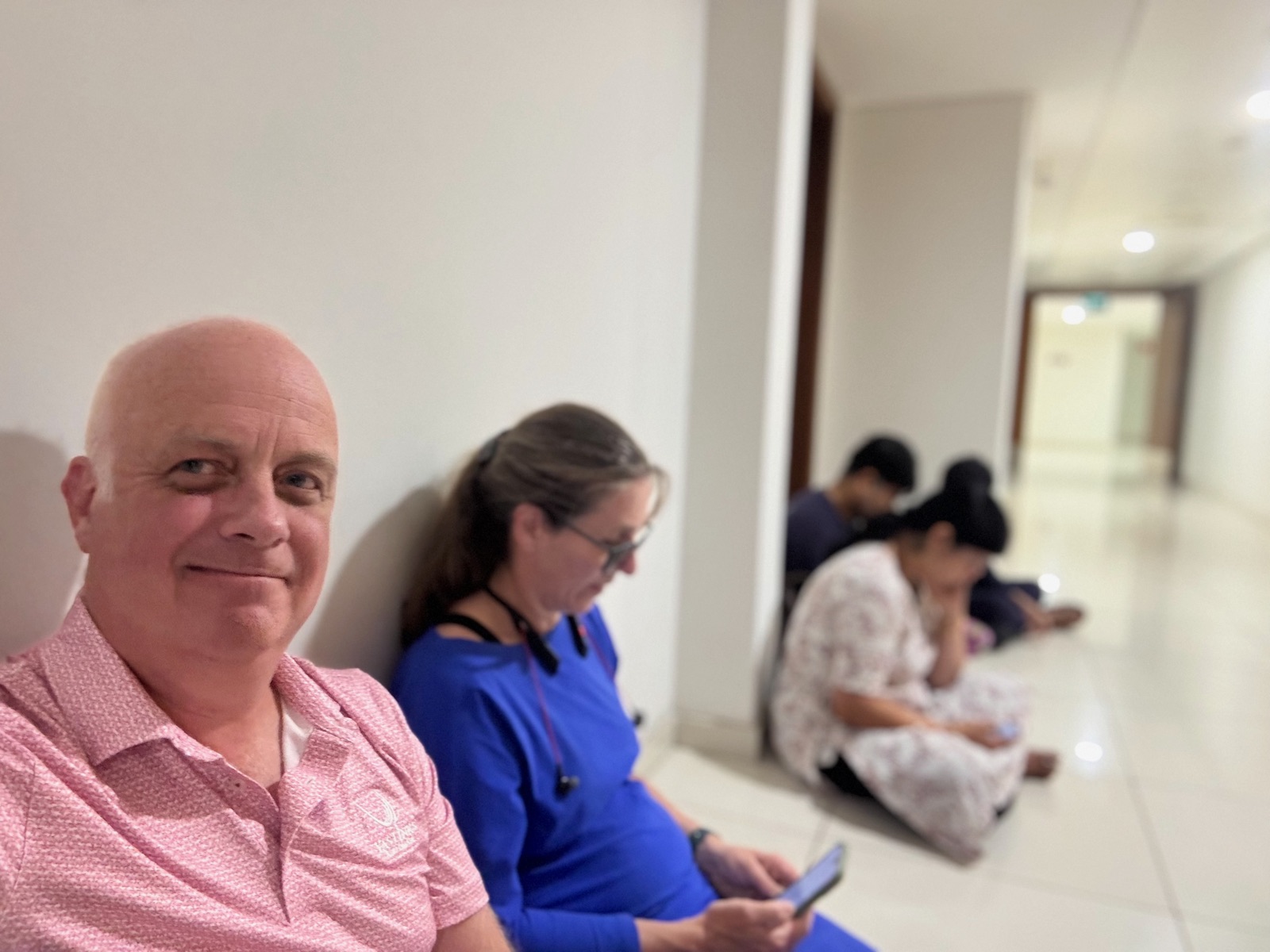
Another alert. Another attack somewhere in the region. Once again a group of neighbours slowly gathered in the basement of the building, a place that in a matter of days had begun to feel almost like a clubhouse.
People brought cushions. Others brought water and phone chargers. Someone checked the news on a phone. Conversations resumed where they had ended the previous evening.
Under normal circumstances neighbours exchange polite words in elevators and corridors. In moments like this something else happens.
Experiences are shared. Backgrounds surface. Connections deepen quickly. A form of traumatic bonding emerges, the quiet recognition that everyone present is living through the same strange moment in history.
The conversations became private, intimate and unusually open. When keeping up appearances no longer served any purpose, people tended to speak honestly.
The same question appeared again and again.
Do we stay? Or do we leave?
People talked about the options they had. What might trigger a decision. What obligations they carried. What leaving would mean for their work, their children and their lives here. And what staying might mean as well.
Then the news was broken.
Our neighbours quietly told us they had decided to leave.
Tomorrow.
In fact they had been packing all day.
For a moment the room fell silent.
Tears followed.
We understood. At the same time we felt two opposite emotions. We were happy for them, because they had made a decision that brought peace of mind. And we were sad that they were leaving.
They felt a sense of guilt for going. For abandoning the life they had believed in so wholeheartedly.
We reassured them that there was nothing to apologise for. This was normal. Everyone was asking themselves the same question.
No one knew what the right answer was. They had made a justifiable decision under uncertainty. And so had those who decided to stay.
For now.
Mobility #
What happened in that basement was not unusual. Across the Gulf expatriate households asked themselves the same question that week: do we stay, or do we leave?
Those who decided to stay often said so. Those who decided to leave usually did not. They simply disappeared. A short vacation. A family visit. A temporary break. A few days later an apartment was empty.
Departures rarely happened in waves. They unfolded quietly, one household at a time.
For more than a decade the UAE benefited from a simple demographic dynamic. More people arrived than left. Economic growth therefore depended less on productivity and more on population expansion. When the number of people working in an economy increases, total output tends to rise with it.
In the UAE that increase has been driven primarily by expatriates.
The structure of society reflects this reality. At the top sit the rulers who define the political and economic framework of the country. Emirati nationals form a small minority of the population but play a central role in national institutions.
Beneath that layer lies a much larger expatriate population responsible for much of the country’s operational and professional activity.
Within that expatriate population an important distinction exists between foreign workers and expatriate professionals. Workers provide essential labour in construction, services and logistics, often under employment arrangements that limit their economic mobility.
Expatriate professionals operate in a different labour market. They manage companies, run financial institutions, design infrastructure, operate technology systems and connect the UAE to global markets. Their skills are internationally transferable and their employment opportunities often extend far beyond the region.
This difference matters.
Expatriate professionals act as the flywheel of the modern Gulf economy. They sustain corporate decision making, drive investment activity and anchor a large share of domestic demand through housing, education, retail and services.
When foreign workers leave they are usually replaced quickly by others willing to take similar roles. When expatriate professionals leave, replacement tends to be slower and often uncertain.
Mobility therefore becomes a strategic variable.
And mobility is often the first place where geopolitical uncertainty becomes visible.
The Promise of Safety #
For many expatriates the UAE offered a simple promise: safety. For years that promise largely held. Abu Dhabi frequently ranked among the cities with the lowest crime rates in the world. Streets were safe, institutions were stable and daily life felt remarkably predictable.
But safety extends beyond crime statistics.
The Gulf has always existed within a geopolitically complex region, and the possibility of conflict has never entirely disappeared. What changed over time was the perception of that risk. As years passed without direct confrontation, stability gradually began to feel structural rather than contingent.
Recent events have disrupted that perception.
Crime remains extremely low and the institutional stability of the country has not changed. Yet the broader sense of geopolitical distance from conflict has shifted. For residents who experienced missile alerts and air defence activity above their own city, regional tensions that once felt abstract suddenly became immediate.
Perception matters because human behaviour rarely responds only to statistics. Decisions about where to live, where to build a career and where to raise a family are shaped as much by perceived stability as by objective measures of safety.
Reversible Shocks #
When tensions rise in the Gulf, international commentary tends to focus on a familiar set of economic indicators: oil prices, gas markets and the security of shipping routes through the Strait of Hormuz.
These risks are real, but they share an important characteristic.
They are largely reversible.
Supply chains can stop abruptly during moments of uncertainty, yet they can restart just as quickly once tensions ease. Tankers resume their routes, ports reopen and trade flows gradually return.
Supply chains have no memory.
Confidence #
Unlike supply chains, confidence behaves differently.
The attractiveness of a country as a place where expatriates are willing to build their lives depends on a deeper form of trust. That trust develops slowly through years of stable experience, but once uncertainty enters the equation behaviour can begin to change much more quickly.
And the first place where that change becomes visible is not in economic statistics.
It is in mobility.
Behaviour Before Data #
Macroeconomic indicators respond slowly to behavioural change. Gross domestic product, employment figures and investment flows reveal trends only after they have already developed.
Human behaviour moves earlier.
In offices, schools and residential communities across the city subtle signals began to appear. Conversations about lease renewals sounded slightly different. Recruiters mentioned that relocation discussions required more reassurance than before. Families quietly explored schooling alternatives abroad for the following year.
None of these signals appeared dramatic in isolation.
Yet together they suggested that something deeper might be shifting.
Human mobility often changes before macroeconomic data does.
Mobility Realisations #
In the days following the attacks a practical question began to appear in many conversations across the city.
Not only whether people would stay.
But how they would leave if necessary.
Until that moment many residents had never seriously considered the mechanics of departure. The UAE had always felt exceptionally connected to the world. Flights departed constantly in every direction.
But looking at a map more closely revealed something interesting.
International mobility depended heavily on two hubs: Dubai International Airport and Abu Dhabi International Airport. Both sat within the same airspace that had suddenly become part of the conflict zone.
An overland route toward Oman existed, but even that revealed small complications people had never previously considered. Something as simple as driving across the border raised questions about whether car insurance remained valid outside the country.
Another reality also became apparent.
In situations of disruption aviation systems tend to prioritise stranded passengers and tourists whose journeys have already been interrupted. Residents, many of whom have homes and resources locally, often find themselves responsible for organising their own departures.
For many expatriates this was a new realisation.
Mobility, something that had always felt effortless, suddenly appeared more structured and more limited than previously assumed.
Mobility Resilience #
That observation leads to a broader strategic point.
Dubai and Abu Dhabi function as extraordinary global gateways. Few places on earth are connected to the world as efficiently.
Yet the concentration of mobility in a small number of hubs also creates exposure.
In periods of geopolitical tension such hubs can become vulnerable chokepoints. Not because the infrastructure itself is weak, but because its importance makes it an obvious focus during conflict.
For a country whose economic dynamism depends heavily on internationally mobile residents, the resilience of mobility itself therefore becomes strategically important.
Additional corridors could increase that resilience. Airports such as Al Ain or Fujairah could provide alternative vectors for international travel, while deeper coordination with neighbouring hubs such as Muscat could expand regional optionality.
The objective is not evacuation.
It is confidence.
People are more willing to build their lives in a place when they know movement in and out remains possible even under stress.
Inflows and Outflows #
Over the past decade the UAE became accustomed to a simple demographic rhythm: more expatriates arrived than left.
That steady inflow supported economic expansion. New residents filled jobs, built companies and contributed to the demand that sustains housing, services, schools and retail.
Periods of geopolitical uncertainty can disturb that rhythm in two ways.
The first change appears quickly. The inflow of new expatriates slows. Companies postpone relocations, candidates hesitate to accept offers and families reconsider moving into a region that suddenly appears less predictable.
The second change is more gradual.
There is always a natural turnover of expatriates. People arrive, build careers and eventually move on. Yet during uncertain periods that outflow can increase slightly.
What matters is who leaves.
Those departing are often not newcomers but individuals already embedded in organisations and networks. They understand regulatory systems, corporate structures and regional markets. Their productivity has already been realised.
When such individuals leave, organisations lose knowledge that cannot be replaced quickly.
Their departure also becomes a signal. Potential newcomers observe experienced professionals choosing to leave and interpret it as information about risk.
The most consequential shift therefore lies not in dramatic departures but in the quiet combination of two trends: fewer new arrivals and a modest increase in experienced departures.
The Summer Test #
The coming summer will provide a natural experiment.
Every year a large share of expatriate families temporarily leaves the Gulf during the hottest months. Schools close, companies operate at reduced speed and many residents spend several weeks abroad.
Under normal circumstances most return.
But the summer also creates a moment of decision.
Families spend time with relatives in other countries. Children explore alternative schools. Employers discuss options within international networks.
The question becomes simple.
How many come back?
Even small changes in that return rate can produce disproportionate consequences in a system that depends heavily on the continuous inflow of internationally mobile professionals.
From Demography to Organisations #
In the days after the attacks this began to surface in many different conversations. With neighbours in the building. With a professor at a university in Abu Dhabi. With teachers at international schools. And in quiet discussions with friends comparing notes about work and what might happen next. The immediate focus everywhere was operational continuity. Yet beneath those discussions another question slowly emerged: how easily could key people actually be replaced if they decided to leave?
The issue was not the total number of workers.
It was the nature of specific roles.
Strategic Labour #
Within most organisations a relatively small group of individuals carries a disproportionate share of strategic responsibility.
These are professionals who understand regulatory frameworks, manage financial risk, maintain complex technological systems or oversee critical infrastructure. Their knowledge rarely exists fully on paper. It lives in experience, relationships and judgement accumulated over years.
When individuals in such roles leave, organisations lose more than manpower.
They lose institutional memory.
Replacing that knowledge takes time. Recruitment can take months. Relocation and integration take longer still.
The challenge therefore is not simply labour shortage.
It is a constraint in strategic labour.
The Tanker Problem #
Large organisations resemble tankers more than speedboats.
Operations continue even when underlying conditions begin to change. Systems keep running, reports are produced and services are delivered as usual.
But strategic capacity can erode slowly beneath the surface.
When experienced professionals depart the organisation may appear stable for some time.
By the time the deeper consequences become visible the structural shift may already be underway.
The Tyranny of the Urgent #
Periods of geopolitical tension concentrate attention on immediate challenges.
Security protocols are reviewed. Communication strategies are updated. Operational continuity becomes the priority.
All of these actions are necessary.
Yet they also create what management thinkers have long described as the tyranny of the urgent.
When urgent operational challenges dominate attention slower structural changes may receive less scrutiny.
Labour mobility is one such change.
The Productivity Paradox #
This dynamic intersects with a longer-term structural observation about the region’s economic model.
Over the past decade much of the UAE’s economic expansion has been associated with population growth. As more expatriates arrived the scale of economic activity expanded with them.
At the same time productivity per worker has not been the primary driver of that growth. Observers of the region have often noted that productivity gains appear more modest than in some other large economic blocs where output per worker has risen more consistently.
As long as expatriate inflows remain strong this model can sustain overall economic growth. A larger workforce generates more activity, more investment and more consumption.
If expatriate inflows slow that dynamic weakens.
One response often proposed is greater reliance on automation and artificial intelligence.
Yet this introduces another complication.
Expatriate professionals are not only workers within the economy. They are also a major source of demand within it. They rent apartments, send their children to schools, consume services, travel, dine and invest locally.
When technology replaces labour it does not only reduce the number of workers required to operate the economy.
It can also reduce the spending power that sustains large parts of that same economy.
Labour in the UAE therefore functions not only as a production input.
It is also a central driver of domestic demand.
The Paradox of Protection #
It is important to recognise that the UAE has undertaken extraordinary efforts to protect residents during recent attacks.
Air defence systems were activated, fighter jets patrolled the skies and emergency alerts reached residents quickly. Many people living here have expressed deep respect for the scale of the effort involved.
Equally significant was the message communicated by the country’s leadership.
Everyone living in the UAE, regardless of nationality, was described as part of the same community. Part of the same family.
In moments of uncertainty such gestures matter.
Yet the source of instability lies largely beyond the country’s borders.
The rockets and drones that triggered recent alerts were launched elsewhere. The broader conflict was initiated by other states, and its ultimate outcome remains uncertain.
The UAE cannot afford to rely on the hope that the situation will resolve quickly with a stable regional environment.
Strategic optionality therefore becomes essential.
Rebuilding Confidence #
If confidence is the variable that ultimately shapes mobility the question that follows becomes unavoidable.
How does confidence return after uncertainty?
Experience suggests that trust rarely begins with policy. It begins with experience.
For many expatriates the decision to move to the UAE was once a leap into the unknown that quickly turned into confidence after arrival. People discovered functioning institutions, personal safety and an international community that made life easier than expected.
In periods of geopolitical uncertainty that sequence can reverse. Families hesitate before arriving rather than after.
Lowering the barriers to first arrival therefore becomes increasingly important.
Housing commitments, school decisions and financial obligations often require families to commit before they have had the opportunity to experience the country themselves.
Creating more flexible pathways into that experience may therefore matter more than economic incentives alone.
Because confidence in the UAE has historically grown not from promises but from lived experience.
Conclusion #
In one basement in Abu Dhabi the question emerged quietly in conversation.
Do we stay or do we leave?
That same question is now being asked in households across the region.
Most families will stay. The Gulf has built decades of stability and opportunity that will not disappear overnight.
But even small shifts in mobility can produce meaningful economic consequences.
Wars are often measured in missiles.
Economies change through something far subtler.
Through the cumulative decisions of people deciding where they and their families will live.
Cite this piece
Schotman, R. (2026). The Overlooked Risk Behind the Gulf Conflict. Outdoor Connect. https://outdoorconnect.ae/library/the-overlooked-risk-behind-the-gulf-conflict/
© Outdoor Connect 2026. All rights reserved. Quote with attribution. Use and attribution