
Essay
The Price of Presence
Reading the UAE property market through presence, not asking prices.
A property market ultimately prices something easy to overlook: the value of a home to the people who will live in it, and how many of them there will be. In the UAE, that number has fallen, and the market has not finished adjusting.
For the past years, prices in Dubai and Abu Dhabi rose faster than rents, faster than construction costs, and faster than any valuation could justify. The market suggested this was a permanent repricing of the Gulf as a safe haven. It rested on one assumption that was never tested: that the population would keep growing. On 28 February 2026, that assumption broke. This analysis explains why a material correction follows from the structure of the market, why it follows even if the government intervenes, and why the asking prices on the portals are the last place it will show.
What the Portals Do Not Show #
On Property Finder and Bayut, the market looks soft but stable. Asking prices hold. Listings are plentiful. But an asking price is what a seller hopes to get, not what a buyer pays. It moves last, and in a downturn it informs least.
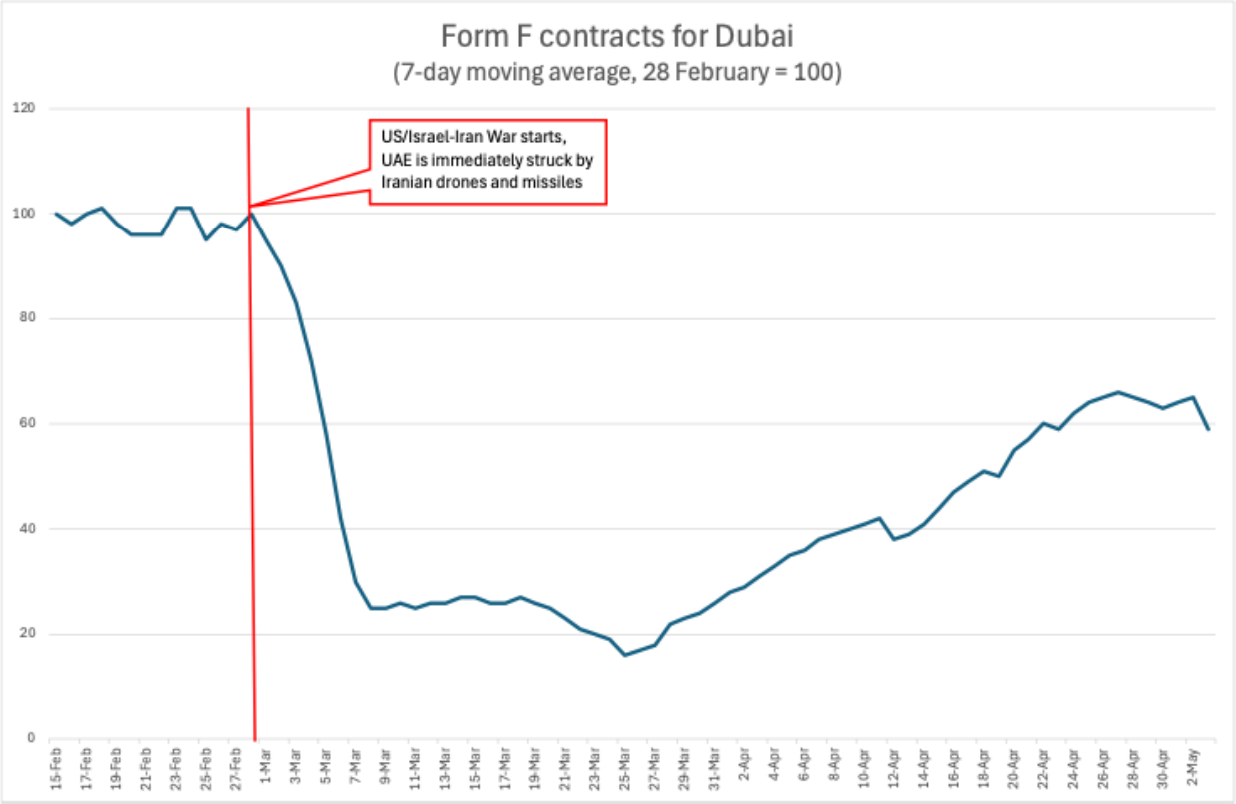
The hardest evidence is the data that records what buyers actually did. In Dubai Form F is the contract registered when a sale is agreed, and these registrations are publicly available, so their volume measures completed deals rather than hopeful listings. This is measured behaviour, not a model. Form F volumes fell up to 84 percent after the conflict began, then recovered only to about 41 percent below pre-war levels. Headline first-quarter sales rose more than 23 percent year on year, but that number measures the market mostly before the war, not during it. On the measure that counts actual sales, the market the portals show as stable had contracted by a third.
That fall has a cause. Transactions did not collapse because sellers withdrew. They collapsed because buyers left, and buyers left because the population that creates demand shrank. Outdoor Connect tracked departure and arrival movements at the UAE's airports and combined them with consistently observed, extrapolated load factors. The flight movements are measured. The load factors are approximated, but the observations were consistent, and they point one way: a large, sustained net outflow in the weeks after the conflict began, on the order of a few million people and for at least March and April. The exact figure is not the point, and the next section explains why.
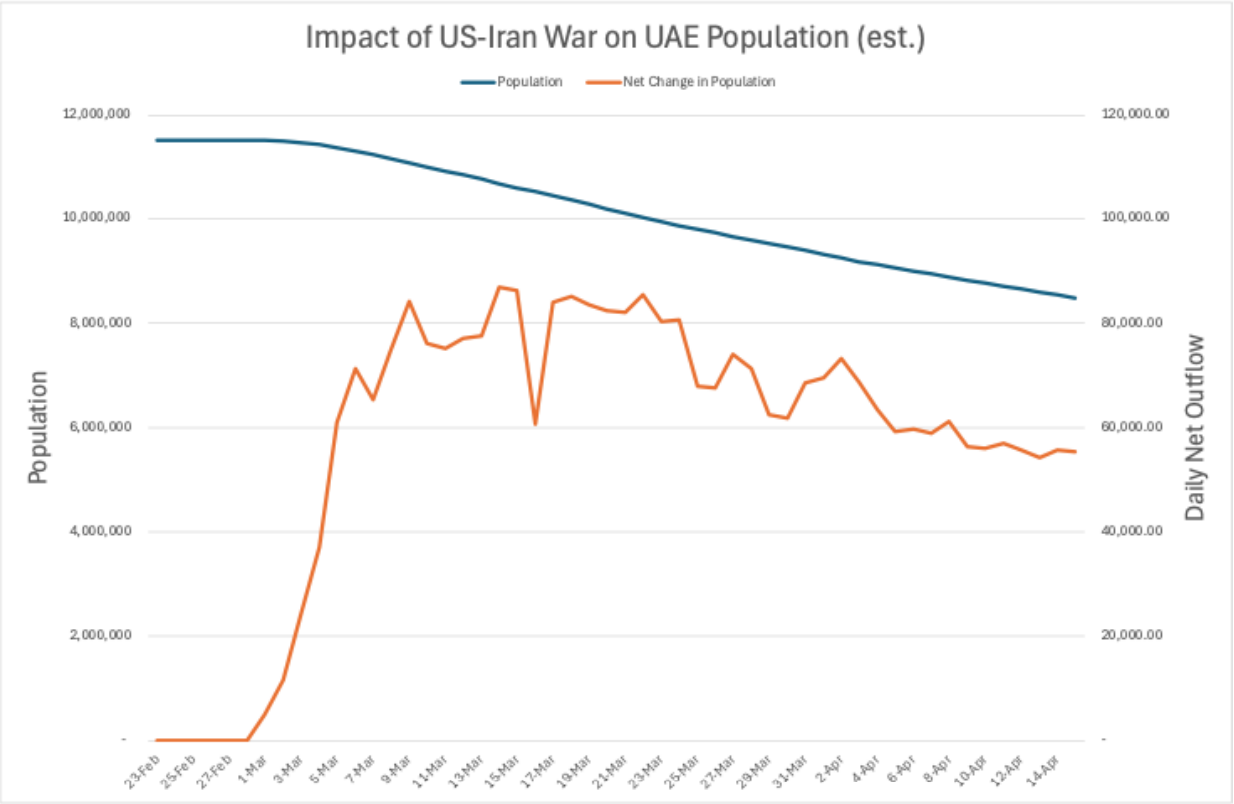
Three measures, read in order of certainty. The asking price is what sellers hope. The transaction data is what buyers did. The flight data is why. The distance between the first and the other two is the correction still to come.
Why Property Is the Pillar That Reveals It #
Earlier work of Outdoor Connect argued that expatriate confidence is the most consequential and most overlooked variable in the regional economy. Confidence touches many markets. Property is the one that converts it directly into a financial asset whose value depends on future presence. A home is a multi-year claim on who will stay and who will arrive. Yet, professionals in the industry have incentives to report “business as usual”. No other market turns confidence into a price so directly, so property registers a change in confidence first and reports it last.
This is why the difference between a cyclical and a structural correction matters. A cyclical correction leaves the rules intact: prices fall, sentiment returns, patience pays. A structural correction breaks the assumptions the price was built on. The Outdoor Connect article Systemic Shock made the point that mistaking the second for the first is the costly error, because the response to a cyclical shock is to wait, and waiting is the wrong response to a structural one.
The Assumption Beneath the Market #
The UAE is not a normal property market. It is a migration-driven economic model. For more than a decade, growth came less from rising productivity than from a rising population, and that population rose because more people arrived than left. Property values were built on the expectation that this would continue. The expectation, not the building, is what carried the price.
The exact numbers do not matter. Whether the UAE began with eleven or twelve million residents, and whether the net outflow is closer to two million or three, does not change the conclusion. The population has contracted materially. For an economy whose growth model rests on continuous expansion through immigration, that is not a statistical detail. It is the broken assumption beneath the market. The question is not how precise the estimate is. The question is that a market priced on permanent inflow now meets outflow.
From there the mechanics are ordinary. Two quantities govern any property market: how many people are present to occupy housing, and how much housing exists. When they move together, prices are stable. When they diverge, price closes the gap. In the UAE both are now moving the wrong way at once, and supply deserves its own attention.
Why Supply Cannot Adjust Fast Enough #
Demand and supply do not adjust at the same speed, and that asymmetry is the heart of the problem. Demand moves through behaviour: a family decides not to renew a lease, a buyer steps back, and that happens in weeks. Supply moves through construction, and construction was committed years ago. The off-plan pipeline financed during the boom keeps completing regardless of conditions, because a developer cannot stop a tower that is financed and half built. The stock built for residents who were expected to come is completing for a population that is leaving.
Sellers can delay, but completed inventory cannot. An owner can hold an asking price and wait; a finished, empty tower carries cost every month it stands unsold. So while demand falls quickly and asking prices fall slowly, supply keeps rising on a schedule set in a different world. This is not a market that drifts back to balance. The two sides are moving apart, and only one of them can move fast.
The Floor Is the Rent, Not the Purchase Price #
A home is worth what someone will pay to live in it. Ownership is a legal wrapper around that rent, and an owner who lives in his property pays himself an implicit rent equal to the income he gives up by not letting it. So the floor under prices is not the price owners paid, nor the price they ask. It is the rent the property can earn from the population that remains, turned into a capital value. Everything above that floor is expectation, and expectation is what changed.
Why the Correction Comes in Steps #
If the market were frictionless, a smaller population would produce a lower price at once. It is not, and the friction sits on both sides. Selling carries cost: a transfer fee, agent commissions, and the cost of holding the property while it waits, so a seller who can afford to wait keeps his asking price high and his listing frozen. But the demand side is no freer. A buyer pays the same fee to enter and faces the risk of buying into a falling market, so the yield investor waits until the discount covers that cost, not merely until the rent justifies the price. Sellers hold too high while buyers enter too late, and between them lies a band in which little trades.
Who leaves that band first depends on financing. The cash owner is anchored and may never sell. The leveraged buy-to-let investor is the most exposed, because his debt is serviced by rent and his rent falls when he can least afford it. When a property is worth less than its loan, the owner cannot sell freely, because the sale will not clear the debt; he holds until default hands the property to the bank, which sells at the bid. Each fall in price pushes more owners below their loan, forcing more selling. The high share of cash ownership in the UAE keeps this group small and contains the spiral, but does not prevent the repricing. One local feature sharpens the timing: default here carries legal consequences far heavier than elsewhere, including travel bans. For a leveraged expatriate, going underwater is a personal risk, not only a financial one, so the rational move is to sell early, while still above water. That pulls selling forward and raises the pressure of the correction, though not its floor, which is set by use against supply.
This breaking of the band is now visible. Luxury Price Drops, a commercial tracker that overlays Property Finder and Bayut, records every reduction in asking price across Dubai and Abu Dhabi, with the deepest cuts beyond 28 percent. Two patterns matter. The number of reductions is rising steadily, which is the clearer signal: a growing share of owners is repricing, so capitulation is accelerating. The honest measure is the ratio of reductions to total listings, not the raw count, which also rises because there are more listings. The deepening of the steepest cuts is weaker evidence, since an old asking price now sits further above a market that has moved. Read together, the rising count is the market doing in plain view what the median asking price conceals: repricing from the bottom up while the surface stays flat. This is the trap BCG calls de-averaging: the mean conceals the distribution beneath it.
A Market That Splits in Two #
A vacant property with no tenant is not a dormant asset. It is a liability: it consumes maintenance, service charges and fees and returns nothing, and if maintenance stops it loses value by decay. This splits the market. Property with a tenant at the new, smaller population has a real floor, set by the rent it earns. Property with no tenant has no floor but its demolition or decay value, because holding it costs money without end.
The pattern is familiar from regions that lost population for good. The one-euro houses of rural Italy show the logic: when supply exceeds the population, the market does not deflate evenly, it sorts. The best stock holds value as the remaining demand concentrates there, and the marginal stock falls out of the market entirely. Decline is a polarisation, not a uniform discount. The UAE differs in one respect that cuts both ways. That Italian decline was slow, demographic, and permanent, while the UAE outflow is abrupt and driven by confidence, and confidence can return. Stock that looks marginal today could be reabsorbed if the inflow resumes, because it is new. But that return is outside the market's control, and because the surplus completing now is new-build, the capital at risk is larger, not smaller.
Why Intervention Cannot Reverse the Direction #
The government response has been substantial and, at the national level, appropriate. One recent sign is telling: a major contractor reports its order book shifting from residential to infrastructure. That shift confirms the thesis, because the building sector is following demand away from residential, but it is also sound policy. Infrastructure serves current and future residents alike, sustaining economic activity through the trough and building the capacity that makes the country attractive to the arrivals it needs. It supports confidence and the wider economy. What it does not do is support the residential price, which still rests on the balance between presence and supply.
This is the limit of intervention. Policy can ease the path, slow forced selling, and redirect activity toward what holds long-term value. What it cannot provide is the one input the market needs, because that input is not money. It is people, specifically the willingness of people who do not yet live here to come.
Confidence has two parts that recover at different speeds. Retention, whether those here stay, recovers quickly, because residents see daily life from the inside and need only to confirm that the stability around them is real. Acquisition, whether new people move, recovers slowly. The outsider decides on perception, commits capital and family over years, and is convinced only by a sustained record of stability after the shock. He also weighs the UAE against alternatives: a mobile professional compares it not with leaving, but with Singapore, Lisbon, and other hubs competing for the same person, each with its own record and none carrying a recent shock. Recruiters already report candidates who once weighed Dubai and Singapore equally now leaning toward the destination that looks more stable. The UAE's appeal has not collapsed; it has shifted at the margin, and the margin is where the inflow is decided.
The market was priced on acquisition, not retention. Existing residents fill existing stock; the new pipeline was built for arrivals who have not come and will not commit until the record exists. Full retention is therefore not enough for a market built on growth. The recent flight data shows the trap. Outbound and inbound volumes have come back into balance, which looks like stabilisation, but total volume is low. A working UAE runs on a permanent net inflow: fuller arrivals than departures, at high volume. Balance at low volume is the population holding steady without growing. For a market priced on growth, that is already decline.
What Remains True #
There is no quick resolution, and it would mislead to offer one. How far prices fall, and for how long, depends on a single variable: whether net inward migration resumes. If confidence recovers quickly and arrivals return after the summer, the correction is shallow and the marginal stock is reabsorbed. If the return is partial, transaction activity stays depressed and prices adjust over several years. If the outflow proves durable and demand resets around a smaller resident base, the repricing is structural and permanent. The same variable separates all three, and it is the one variable policy cannot manufacture.
For anyone with exposure, the implication is to watch the right instruments. The asking prices on the portals and the published price index both read calmer than the market is, and both reassure at the wrong moment. The measures that matter set the floor: the resident population that anchors the rent, and the direction of the migration flow that decides whether the floor rises or falls. In practice, watch total flight volume and the direction of its asymmetry rather than asking prices, watch the ratio of price reductions to total listings rather than the median, and ask of any single asset whether it has a tenant at the new population rather than what it fetched at the peak. The market has not ended. It has returned to the question it stopped asking three years ago: how many people will choose to be here, and what is a home worth to them.
Cite this piece
Schotman, R. (2026). The Price of Presence. Outdoor Connect. https://outdoorconnect.ae/library/the-price-of-presence/
© Outdoor Connect 2026. All rights reserved. Quote with attribution. Use and attribution