
Freedom to Operate · Part 1 of 2
Freedom to Operate – An Introduction
An introduction to the Outdoor Connect board framework

The rules moved. The firms did not #
In September 2025, several companies in the Gulf unexpectedly lost access to Claude, Anthropic's large language model. Nothing inside those companies had changed. No contract had been breached, no government had intervened, and their own conduct remained exactly as before. Anthropic had simply revised its terms of service, excluding organisations more than 50% owned, directly or indirectly, by companies headquartered in unsupported regions, a group it confirmed included China, Russia, Iran and North Korea.
The technology was still there. The companies were still there. What had disappeared was the permission to use it.
That distinction is more significant than it first appears. For most of modern corporate history, ownership has been treated as the foundation of strategic control. A company owned its assets, and those assets enabled it to execute its strategy. Increasingly, that assumption no longer holds. Today, firms depend not only on what they own, but also on permissions granted by organisations that sit outside their corporate boundaries. Cloud providers, payment networks, AI developers, platform operators and regulators increasingly determine whether critical capabilities remain available.
Freedom to Operate begins with that observation. Ownership determines what a firm possesses. Permission determines what it is actually free to do. Those are no longer the same thing.
A company may own its products, its customer relationships, its data and the infrastructure on which they operate, yet still depend on someone else's permission to deploy an AI model, move data across borders, settle payments or continue serving a particular market. The strategic vulnerability is therefore not created by the asset itself, but by the external authority that retains the ability to withdraw access to it.
Governance rarely distinguishes between ownership and permission. It assumes that control follows from possession. Increasingly, it does not. As capabilities become embedded in external platforms and jurisdictions, firms continue to own the assets on which their strategy depends while losing direct control over the conditions under which those assets can be used.
Freedom to Operate is built around that gap. It asks boards not simply what the company owns, but which external permissions its strategy depends upon and who ultimately controls them.
Dependency has become an instrument of power #
The events in the Gulf were not an isolated incident. They exposed a structural change that now runs through much of the global economy. For several decades, companies viewed interdependence primarily as a source of efficiency. Activities migrated to whichever organisation could perform them most effectively, supported by the assumption that mutually beneficial relationships were also relatively stable. That assumption still holds in many situations. It is no longer sufficient as the basis for strategy.
The reason lies in the architecture of modern networks. Digital markets tend to concentrate around relatively few providers. Cloud infrastructure, payment systems, technical standards and frontier AI models all exhibit strong network effects, making them increasingly difficult to replace once they become established. As a result, organisations that control these capabilities do not merely supply them. They also acquire the ability to determine who may continue to use them.
Much of what modern economies have built now rests on capabilities owned and governed elsewhere. We call that condition borrowed freedom: the firm can act, but part of its ability to do so is held by someone else. Peter Drucker read this same unbundling, a generation ago, as efficiency, arguing that the corporation of the coming society would keep little more than its top management and contract out almost everything else. On the cost of doing business he was right. What his account leaves unpriced is the permission that leaves with the work. Each function handed to whoever performs it best also hands that party the standing to withhold it, and borrowed freedom is the other side of that bargain. It stays invisible until someone decides to call it in.
The shift is subtle but fundamental. Dependencies of this kind increasingly run through organisations that have no ownership stake in the firm itself, yet hold the authority to constrain its freedom of action. The critical question is therefore no longer whether a company depends on others. Every company does. It is which of those dependencies give another organisation the practical ability to say no.
Freedom begins with strategy #
For that reason a framework built on dependency cannot start from a list of dependencies. A risk register (an Enterprise Risk Management framework, say) works from the threats it can name, and its limit is structural rather than procedural: it holds only what the organisation was able to imagine, and the losses that matter tend to arrive from the entry no one could have written down. Begin with the suppliers, the technologies and the jurisdictions and you have only rebuilt that register under a new name.
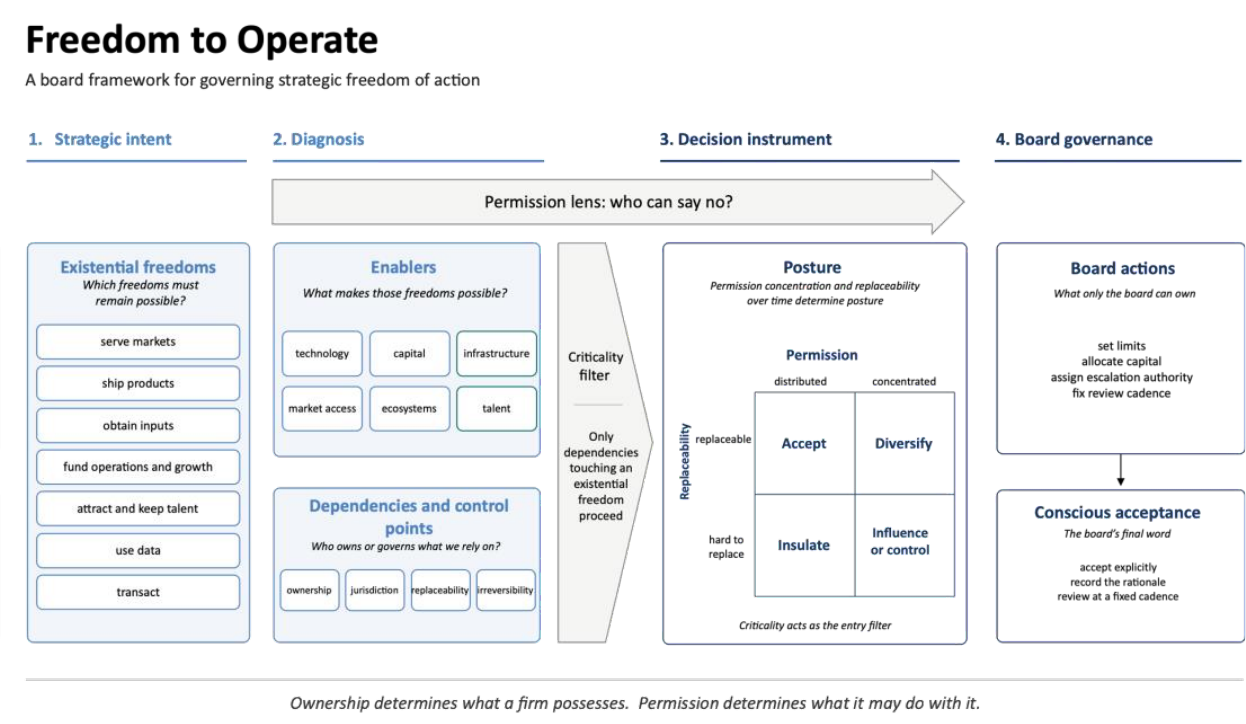
Freedom to Operate runs the other way. It starts not from the threats, which are open-ended and never fully knowable, but from the freedoms a strategy cannot do without, which are few and follow from the strategy itself. An unknown threat is still caught, not because it was foreseen, but because it has to pass through a freedom that was already named. The analysis moves from an open-ended list of possible threats to a bounded set of freedoms defined by the strategy itself.
The same dependency carries very different weight from one firm to the next. A cloud outage that halts a payments platform within minutes is a grave problem; the identical outage at a firm running overnight batch jobs is a nuisance. Same technology, quite different freedom at stake.
For one company the freedom that matters most is the ability to keep serving a chosen market, or to secure a critical input. For another it is moving data across borders, or attracting scarce talent, or funding growth, or simply staying able to transact. A freedom is existential when losing it would break the strategy, threaten the firm's continuity, or set it back further than it could afford to recover from. Each such freedom rests on a set of enablers: technology, capital, infrastructure, market access, ecosystems, talent. The question worth asking about them is not how many there are but who stands behind them. Who owns them, whose law governs them, how fast they could really be replaced, whether the dependency could be reversed at all. A dependency matters, in the end, only because of the freedom sitting behind it. The ones that touch no existential freedom belong in the ordinary machinery of operational, vendor and enterprise risk. They can stay there, and they do not need to reach the board through this assessment.
Assessed this way, Freedom to Operate is not a bigger vendor-risk register. It is a way of finding where a firm's freedom of action actually lives.
The board must choose a posture #
Diagnosis, though, is not yet a decision. Whatever passes the test of criticality is then weighed on two questions: how fast the dependency could realistically be replaced, measured against the time the firm would actually have, and how concentrated the power to deny it is. The two answers together point to a posture.
A dependency that is easily replaced and spread across genuinely independent hands can be accepted as it stands. Where a single party can withhold it, the answer is to diversify, but only across alternatives that do not rest on the same jurisdiction, infrastructure or standard, since duplicating a hidden common dependency achieves nothing. Where replacement is slow but permission is widely held, the firm insulates itself instead, building reserves, fallback capacity and contractual protection. And where replacement is slow and permission sits in a single set of hands, the exposure is at its sharpest. Here the options narrow: influence the party that holds the gate, build a credible substitute, reshape the strategy around the constraint, or take control of the node outright.
None of these postures is free. Diversification duplicates capacity. Insulation ties up capital before it is needed. Influence costs access and time, and control redraws the boundary of the firm itself. A posture the board has not priced, and not chosen to fund, is not yet a decision.
The work divides in a particular way. Management maps the dependencies, develops the options and carries out whichever posture is chosen. The board's part is narrower, and much harder to hand off: it decides which freedoms are non-negotiable, sets the limit on how much concentration it is willing to live with, approves the risk appetite and the capital behind it, and settles in advance what must happen before an exposure is escalated or reopened. The analysis and the execution can be delegated; the accountability for the trade-off stays with the board.
What all of this builds toward is quieter than the manoeuvres before it: a decision the board takes in its own name, to accept a given dependency with its eyes open. Where the board chooses to live with one, the decision is worth writing down in full. Record the freedom at stake, the party being relied on, the reasons and the assumptions underneath them, the person who owns the exposure, the events that would force a rethink, the cost of moving if it came to that, and the date the decision will next be looked at. Set down that way, acceptance stops being passive tolerance and becomes a governed choice: to rely on someone else's permission, on terms the board has stated and can defend.
Strategy defines direction. Governance decides which external permissions the firm is willing to rely on, and on what terms.
Freedom cannot be assumed #
No board can remove dependency altogether, foresee every political decision, or bring every capability its strategy needs inside its own walls. The attempt would be ruinously expensive and, more often than not, self-defeating. What a board can do is smaller and more useful than that. It can decide which freedoms genuinely matter, work out who is in a position to constrain them, and choose its posture while alternatives still exist and preparation is still cheap.
A board is not at fault for depending on others; every strategy does. It is at fault when it lets a dependency turn binding without anyone having examined it, priced it, and consciously chosen to accept it. Freedom to Operate is the discipline of telling the two apart.
Analytical foundations #
The framework draws together several established lines of thought. Henry Farrell and Abraham Newman show how the hubs and chokepoints of a network turn interdependence into leverage. Ronald Coase and Oliver Williamson supply the economics of where a firm’s boundary should fall, and whether a critical capability should be bought, governed or owned outright. Susan Strange’s account of structural power explains how those who shape the rules shape the options left to everyone else. Peter Drucker puts strategic purpose before the operational choices that follow from it. The full framework, Freedom to Operate: A Board Framework for Governing Strategic Freedom of Action, is published at outdoorconnect.ae/insights.
Source note. Anthropic, “Updating restrictions of sales to unsupported regions,” 4 September 2025. Anthropic stated that the restriction included entities more than 50 per cent owned, directly or indirectly, by companies headquartered in unsupported regions, regardless of where they operated. An Anthropic executive confirmed to the Financial Times that the policy also applied to entities controlled from China, Russia, Iran and North Korea and took effect immediately.
Cite this paper
Schotman, R. (2026). Freedom to Operate – An Introduction. Outdoor Connect. https://outdoorconnect.nl/library/freedom-to-operate-an-introduction/
© Outdoor Connect 2026. All rights reserved. Quote with attribution. Use and attribution