Freedom to Operate · Part 1 of 2
Freedom to Operate – An Introduction
Ownership no longer guarantees freedom of action. Why boards must know which external permissions their strategy depends on, and who can withdraw them.

Framework 02 of 03 · 01 Strategic Growth · 03 Strategic Leadership
Why ownership no longer guarantees freedom of action.
In September 2025, several companies in the Gulf unexpectedly lost access to Claude, Anthropic’s large language model. Nothing inside those companies had changed. No contract had been breached. The technology was still there. The companies were still there. What had disappeared was the permission to use it.
Ownership determines what a firm possesses. Permission determines what it is actually free to do. Those are no longer the same thing. Governance rarely distinguishes between ownership and permission. It assumes that control follows from possession.

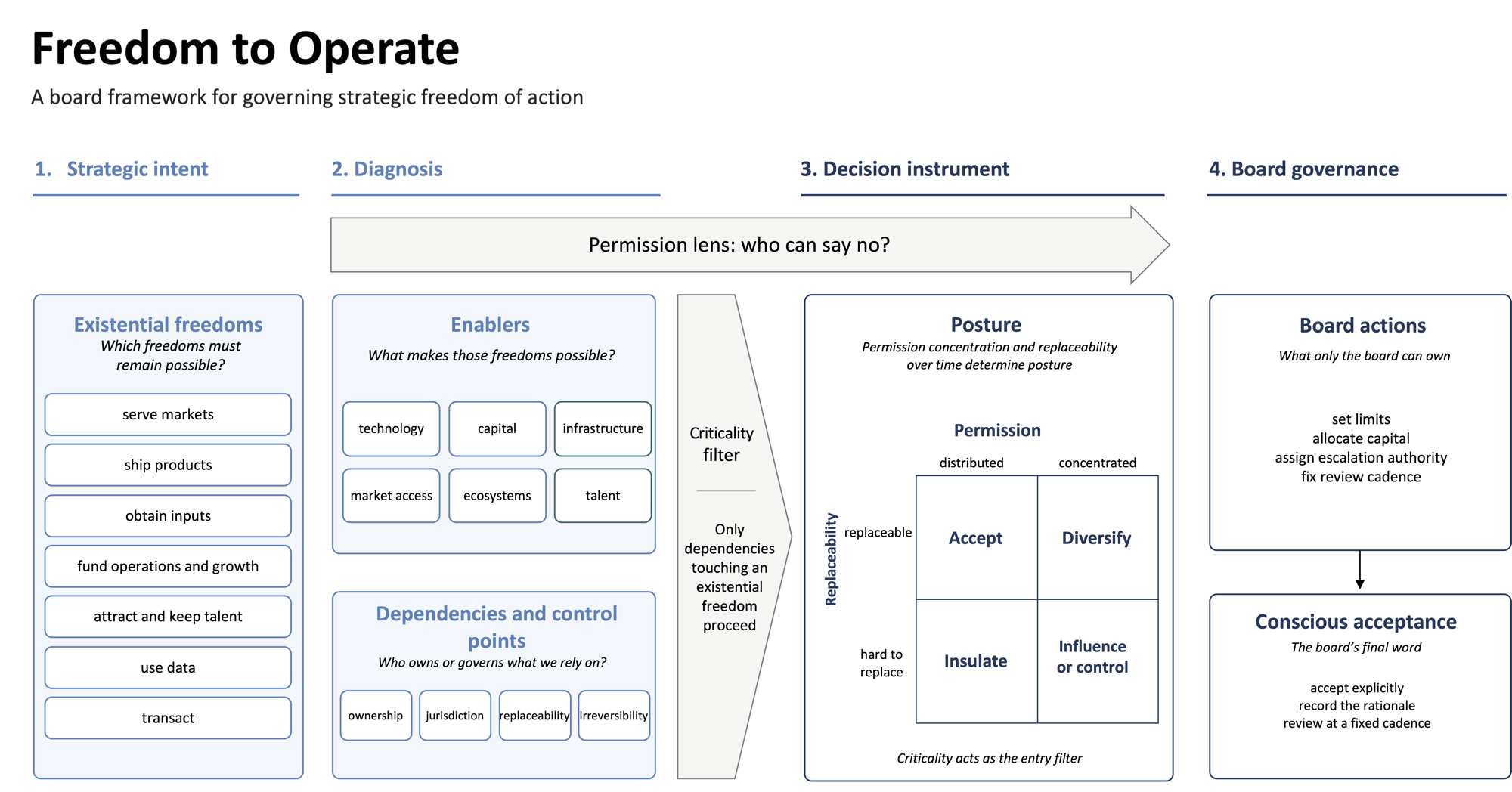
Instrument
The critical question is no longer whether a company depends on others. Every company does. It is which of those dependencies give another organisation the practical ability to say no. Answer three questions. The framework points to a posture; the board still has to price it and choose.
Where the board chooses to live with a dependency, record the freedom at stake, the party being relied on, the reasons and the assumptions underneath them, the person who owns the exposure, the events that would force a rethink, the cost of moving if it came to that, and the date the decision will next be looked at. Sources: Freedom to Operate: An Introduction; Freedom to Operate: The Framework, Parts V to VII and the Exposure Map.
 Freedom to Operate · The Gulf, 2025
Your AI supplier withdraws access. No contract was breached.
Trust the supplier and wait, or bring every capability in-house?
 Freedom to Operate · The Netherlands, 2025–2026
A supplier behind DigiD may be acquired by an American company.
Treat it as a technical security matter, or block this one takeover?
Freedom to Operate · Part 1 of 2
Ownership no longer guarantees freedom of action. Why boards must know which external permissions their strategy depends on, and who can withdraw them.
Freedom to Operate · Part 2 of 2
A board framework for governing freedom of action: which freedoms are existential, who can constrain them, and which posture to choose before the question is forced.
Essay
AI may advise, but who still signs? The decisions boards must never delegate to machines, and how AI can quietly erode the purpose of a company while claiming efficiency.