
The 2026 Iran-War Series · Part 4 of 9
The Silent.
A work of strategic fiction
He was fifty-six when he became one.
The Ceiling #
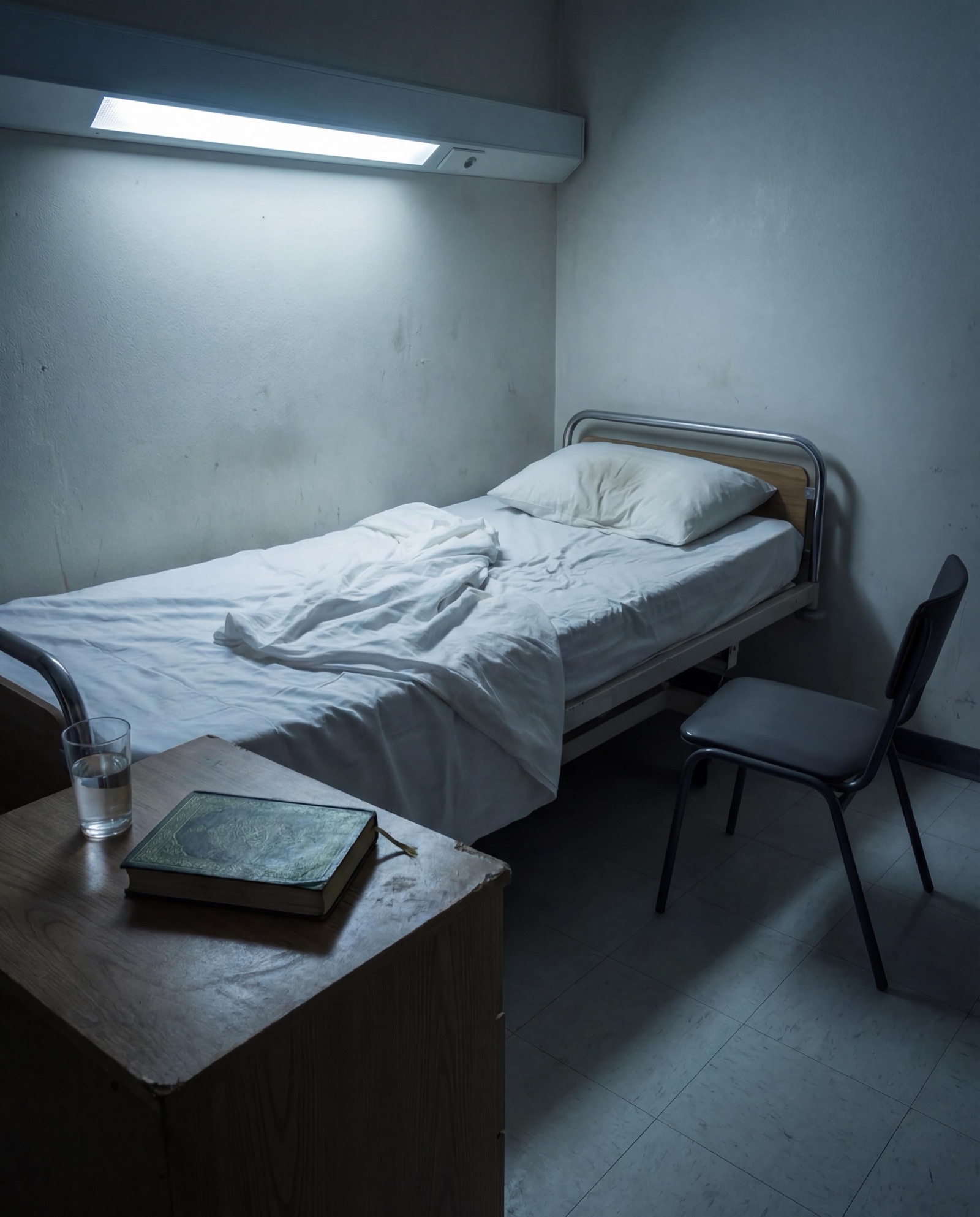
The ceiling is white.
He has learned its every detail. A crack near the light fixture, no wider than a finger, runs three centimeters toward the wall before stopping. The doctors have not noticed it. Or perhaps they have and consider it unimportant. He considers nothing unimportant. He never has.
The room has no windows. The location is unknown to everyone except the four who visit and the doctor who does not leave. This is not an accident. Everything about this room is deliberate.
He lies still. The stillness is not weakness. Anyone who has watched him over the years — and very few have been permitted to watch him, closely, for long — would recognise this stillness as a form of concentration. He is not resting. He is working. The work has simply moved entirely inward.
His body, what remains of it, reveals nothing. The Pentagon said he was wounded and likely disfigured. They said it as if disfigurement would diminish him. They have never understood what he is.
Somewhere in his mind, in rooms that no one else can enter, he is moving things. Pieces on a board that exists only there. Sequences. Timings. The order in which events must occur so that the larger event becomes inevitable.
He was groomed for this from the age of nine. Perhaps earlier. His father’s arrests, the boots on the floor, the agents who came in the winter — these were not interruptions to his childhood. They were his education. The Revolution was not something that happened to his family. It was something his family was.
On the table beside the bed: a glass of water. A small Quran, worn at the spine. Nothing else. No telephone. No documents. No connection to the world except through the four who come and the doctor who stays.
He has one thing left to give.
He is deciding when.
The Soldier #
The soldier comes in the early afternoon. He is the same age as the man in the bed, give or take a year. They were seventeen together in the mud of the southern front. That is a bond that has no name in the language of institutions. It only exists between men who carried the same dead.
He sits without greeting. He has not greeted him in thirty years. Greetings belong to the formal world, the world of titles and protocols. Between them there is only the older language.
He speaks in facts. He always speaks in facts. This is why he was chosen for this room, for this circle of four. Everyone else wraps the facts in what they believe their leader can bear. This man does not. He has been trusted with the truth for forty years and he has never abused that trust.
The missiles. The number is smaller than it was. Much smaller. He states the percentage without inflection. The man in the bed does not react. He continues.
The launchers. Gone, most of them. The Americans have been systematic and precise. He says this without bitterness. It is simply what it is.
Then the drones. Here his tone changes very slightly. Not with emotion. With something closer to precision, the way an engineer changes tone when explaining a system that is working as designed.
Decentralized. Inexpensive. No launcher required. A truck. A field. Minimal training. They cannot bomb the knowledge. They cannot bomb the hands. The cost of launching is a fraction of the cost of intercepting. The mathematics has not changed. The mathematics has never favored the Americans in this kind of war. They confuse firepower with strategy. They always have.
Then the pause.
He does not say where. He does not say how many. He says only:
“It is safe. It is waiting.”
The man in the bed looks at the ceiling. The crack. Three centimeters. He is still for a long moment. What passes through his mind during this stillness cannot be known. It is possible he is thinking of his son. It is possible he is thinking of nothing except the next question. With him, these two things may not be different.
He asks one word.
“When?”
The soldier understands. Not the war. Not the storage. The final step. The crossing.
He says a number. Months. Single digits.
The man in the bed is motionless for three, four seconds. Then a movement so small it would be invisible to anyone who did not know what to look for. A fractional inclination of the head.
The soldier stands. At the door he pauses. He does not turn around.
“We have been building this since before they knew our names.”
He leaves without waiting for a response. There is no response required. They both know it is true.
The Cleric #
The old cleric comes without announcement. He has never announced himself. He was the father’s teacher before he was the son’s. He is perhaps eighty. His hands tremble slightly. His voice does not.
He begins reciting before he has fully settled into the chair. The words arrive before the man does. This is his habit and the man in the bed has always found it, in some way that resists precise description, calming. As if meaning were more reliable than presence.
Hussain. Karbala. The tenth of Muharram, 680. A man who knew what was coming. Who went forward anyway. Not because victory was certain. Because the act was its own answer.
The man in the bed listens. Those who have been in this room during these visits report that something changes in him when the old man speaks. The calculation behind the eyes becomes something else. Not softer. Different. As if for a brief time he is permitted to be something other than what the system requires him to be.
He was shaped by this story from infancy. His father used it. The Revolution was built on it. Every soldier sent to the front carried it. And now the story has come for him personally, the way it always comes eventually for those who have spent their lives invoking it.
He waits for a pause in the recitation. Then:
“My father had a fatwa.”
The old man stops. He looks at his hands. He has been waiting for this conversation for some time. Perhaps since before the war. Perhaps much longer.
“Yes.”
The man in the bed speaks quietly. Without heat. In the measured cadences of someone who has constructed this argument over many nights and is now presenting the finished form.
Gaddafi surrendered his program. Assad had none. Both are gone. Kim kept his. Kim remains. The lesson of the last twenty years, he says, is not complicated. It requires no interpretation.
They bombed his country while his negotiators were preparing to travel. While Iran sat at the table in good faith, the order was given. The fatwa was issued in a world where the threat of force served as deterrent. That world ended on the twenty-eighth of February.
The old cleric is quiet for a long time. Then:
“A fatwa can be revised when circumstances require revision. The law serves the community of believers. If the absence of the thing has become the threat to the community, then the law, correctly understood, demands reconsideration.”
“Your father was a great man. He issued his fatwa in a world where the threat of force had not yet been used against us. That world no longer exists.”
The man in the bed closes his eyes.
The cleric begins to recite again. Hussain. Karbala. The act that requires no victory to be complete.
What the man in the bed thinks during this recitation is not known. His face shows nothing. His breathing slows. He may be praying. He may be calculating. He may have arrived at the point where these two things are the same.
The Gatekeeper #
He comes last. He always comes last. He wants to know what the others have brought before he speaks. This is method. He learned it here, in this room, over the years when the man in the bed was the one who moved in the shadows and he was the one who watched and learned.
He is family. A nephew. He has the patience of the Khamenei line and a coldness that is entirely his own. He is what the man in the bed was for thirty years: the invisible hand, the arranger, the presence that shapes events without leaving marks on documents.
He has been managing the system since the injury. Every appointment, every removal, every consolidation. He does it in the name of the man in the bed. That name still opens every door. It will for some time yet.
He briefs quickly. A deputy minister repositioned. Two commanders whose loyalty had become uncertain reassigned to distant postings. A journalist who had begun to ask specific questions about the leadership’s health is no longer asking questions. The account is efficient. He does not use the word killed. He does not need to.
The man in the bed listens. He nods at appropriate intervals. This is the maintenance work. The daily labour of keeping the system intact while the larger work proceeds. You do not build something consequential and leave the foundation unguarded.
Then the gatekeeper pauses.
There is a name. A member of the Assembly. An older man, a man of conscience who has begun asking questions. Quietly. About legitimacy. About the direction of the leadership. Not openly hostile. More dangerous than that.
The gatekeeper waits.
The man in the bed looks at the ceiling. The crack. Three centimeters from the lamp.
The gatekeeper is very good at waiting. He was taught by the best.
The man in the bed closes his eyes. When he opens them he is looking at the ceiling still. He does not look at the gatekeeper.
The gatekeeper understands. He stands. He will try again tomorrow. He has learned that some decisions require more than one night.
At the door he stops.
“The world is changing faster than we anticipated.”
No response.
“We must move faster than the world.”
The man in the bed turns his head. He looks at his nephew. A long look. There is something in it that the gatekeeper, despite everything he has learned, cannot read completely. It may be pride. It may be a warning. It may be both.
“No.”
One word. The gatekeeper leaves.
The room is quiet.
The man in the bed looks at the ceiling again.
He will be what I was, the man thinks — or perhaps does not think, perhaps simply knows, in the way you know things you have always known. That is enough. That is more than enough.
But there are things that will not be given. Not tonight. Perhaps not ever.
Some lines are not crossed even by the man who has spent his life crossing lines. No one outside this room will ever know where those lines are. That is also a form of power.
The Night #
The doctor sleeps in the chair by the door. He sleeps the same way every night. Upright, hands in his lap, head slightly forward. A man who has learned to rest in positions of readiness. He is the only one in the circle of four who was not chosen for loyalty to the system. He was chosen for his skill. This distinction matters to the man in the bed in a way that is difficult to explain.
The doctor wants only one thing from his patient. He wants him to survive. Not for Iran. Not for the revolution. Not for the program. For the medical reason that this is his patient and he has sworn an oath. There is a freedom in being cared for by someone who needs nothing from you except your continued existence.
The night is quiet. The generator outside the door has cycled down. No footsteps. Somewhere, perhaps, bombs are falling on buildings that used to be Iranian. Or missiles are being tracked by American radar. Or tankers are anchoring outside the Strait, waiting. The war continues without his instructions. That was always the design. The system does not require its leader to act. It requires its leader to exist.
He exists.
He thinks of his father. Not the portrait. Not the Supreme Leader whose face was on every wall of every government building for thirty-seven years. The man who held his hand when they came in the winter and told him: tell them I am not here. He was six years old. He told them.
He has been telling them ever since. That he is not here. That the power is elsewhere. That the center cannot be located or targeted or eliminated because the center is everywhere and nowhere simultaneously.
His father did not want this for him. There are people who know this. His father said as much, in private, near the end: the succession should not be blood. But the system chose blood because systems choose what they know. And the system knew this blood.
The doctor’s breathing is slow and regular.
The room absorbs the silence.
At some point in the deep middle of the night — the hour cannot be fixed because no clock is visible and no one is awake to witness it — the man in the bed speaks.
It is not loud. It is barely audible. In Arabic. The classical formulation, the language of law and revelation and the fourteen centuries of obligation that precede this moment.
He does not recite the full text. He recites the core. The revision. The grounds. The new obligation that the new reality requires. The words are precise and brief and carry the weight of everything that has led to them.
The doctor does not stir.
The room absorbs the words the way it absorbs everything: completely, silently, without record.
He closes his eyes.
By morning the gatekeeper will know. It is not clear how. Perhaps one of the medical staff passes a signal. Perhaps there is a system for this that has been prepared in advance and never discussed openly. The how does not matter. What matters is the certainty: by morning he will know.
And then the months the soldier named will begin.
And the cleric will begin composing the theological framing that carries the words into the institutions, into the seminaries, into the doctrine of a system that must believe what it does is sanctioned by something older and larger than strategy.
And the doctor will sit in his chair and do what he has always done.
He will keep his patient alive.
One day at a time.
For as long as it takes.
Somewhere in Iran, in a garage on an ordinary street in an ordinary city, a cylinder is waiting.
The neighbour thinks it is a gas tank.
The owner of the garage does not know what is inside.
Only one man knows all the addresses.
He is waiting for a nod from a room whose location no government knows.
The Americans destroyed the buildings.
They could not destroy the decision.
He only had to breathe.
That was always enough.
Author’s Note: What Happens If Iran Becomes a Nuclear Power #
This story is a work of strategic fiction. Mojtaba Khamenei is a real person. The events described — his injuries, the deaths of his family, his appointment as Supreme Leader, the war itself — are drawn from public reporting as of March 2026. His inner life, his conversations, and the specific decisions attributed to him are invented. The strategic logic that drives the story is not.
The central analytical question this story poses is one that Robert Pape, professor at the University of Chicago and advisor to every White House since 2001, has asked publicly and without receiving a credible answer: why, exactly, is Iran not going to develop nuclear weapons? The satellite imagery above Fordow in the days before the strikes, the classified DIA assessment that Iran’s nuclear program was set back only months, the absence of IAEA inspectors, the 400 kilograms of highly enriched uranium whose location remains unknown — these are facts, not fiction.
What follows from an Iranian nuclear capability is the question this story leaves open. The answer is not reassuring.
The first consequence is the permanent end of deterrence. The logic has been demonstrated by history. Gaddafi surrendered his program and was overthrown. Assad had no program and was removed. Kim Jong Un retained his and remains in power. The lesson every regional leader draws from the 2026 war is identical to the lesson Pyongyang drew decades earlier: nuclear weapons are the only reliable guarantee against regime change. The threat of force, which was the primary deterrent against Iranian weaponization, has been spent. It cannot be used again.
The second consequence is Saudi proliferation, and it is not speculative. Mohammed bin Salman stated publicly in 2018 that Saudi Arabia would acquire nuclear weapons if Iran did. Pakistan’s defense minister has confirmed that his country’s nuclear program will be made available to Saudi Arabia. The agreement between Riyadh and Islamabad is documented, decades old, and materially funded by Saudi money. The day Iran tests, Saudi Arabia makes a phone call. The transfer would be measured in weeks.
The third consequence is regional cascade. Turkey, Egypt, the UAE — each carries its own calculation, its own threat perception, its own political logic that is transformed by the simultaneous existence of a nuclear Saudi Arabia and a nuclear Iran. The IAEA director-general warned in September 2025 of a world with twenty or twenty-five nuclear-armed states. The war has made that outcome more likely, not less.
The fourth consequence is the end of the Non-Proliferation Treaty as a functioning instrument of international order. The NPT rested on a bargain: non-nuclear states forgo weapons in exchange for security guarantees. The 2026 war has demonstrated that security guarantees from nuclear powers are worthless when those powers decide to strike. The NPT did not die in a negotiating room. It died above the skies of Tehran.
The war was launched to prevent nuclear proliferation. Its most consequential strategic outcome is the greatest wave of nuclear proliferation in the history of the atomic age. This is not a political judgment. It is the conclusion of the logic this story has followed from its first page.
The United States entered the war with overwhelming military assets. Iran entered it with the control points that determine endurance. And in a room whose location no government knows, a man who has spent fifty years building a system designed to outlast any attack is breathing quietly in the dark.
He only had to breathe.
The rest was already in motion.
Cite this piece
Schotman, R. (2026). The Silent.. Outdoor Connect. https://outdoorconnect.ae/library/the-silent/
© Outdoor Connect 2026. All rights reserved. Quote with attribution. Use and attribution