
Essay
The Confidence Equation
Why the economic cost of the Gulf conflict is behavioural, not physical.
The UAE’s air defence system has performed with exceptional effectiveness throughout the Gulf conflict. Ballistic missiles, cruise missiles and drones have been intercepted consistently, day after day, with a professionalism that deserves recognition. The physical damage is real. Two Amazon Web Services data centres have been destroyed. Critical infrastructure has been hit. Hotels, an airport fuel depot, a tanker in Dubai Port and more have been struck, either direct or by debris. These are facts that matter.
But they are not the facts that will determine the UAE’s economic trajectory.
A sustained drone and missile campaign costing tens of millions of dollars can generate economic consequences measured in hundreds of billions. Not through what it destroys, but through what it causes people to decide. The control point that powers the UAE’s economy, the ability to attract international professional talent to live and build here, is under sustained pressure. Not because the country has failed in its defence. But because the threat itself, by its mere continued existence, erodes the confidence on which that ability depends.
As of this writing, a ceasefire has held since April 8. Kinetic conflict between the US and Iran has not resumed. But the Islamabad talks have collapsed, and the conditions that produced the conflict remain unchanged. The mechanism this essay describes does not require active bombardment to operate. Uncertainty alone is sufficient.
What the Data Shows #
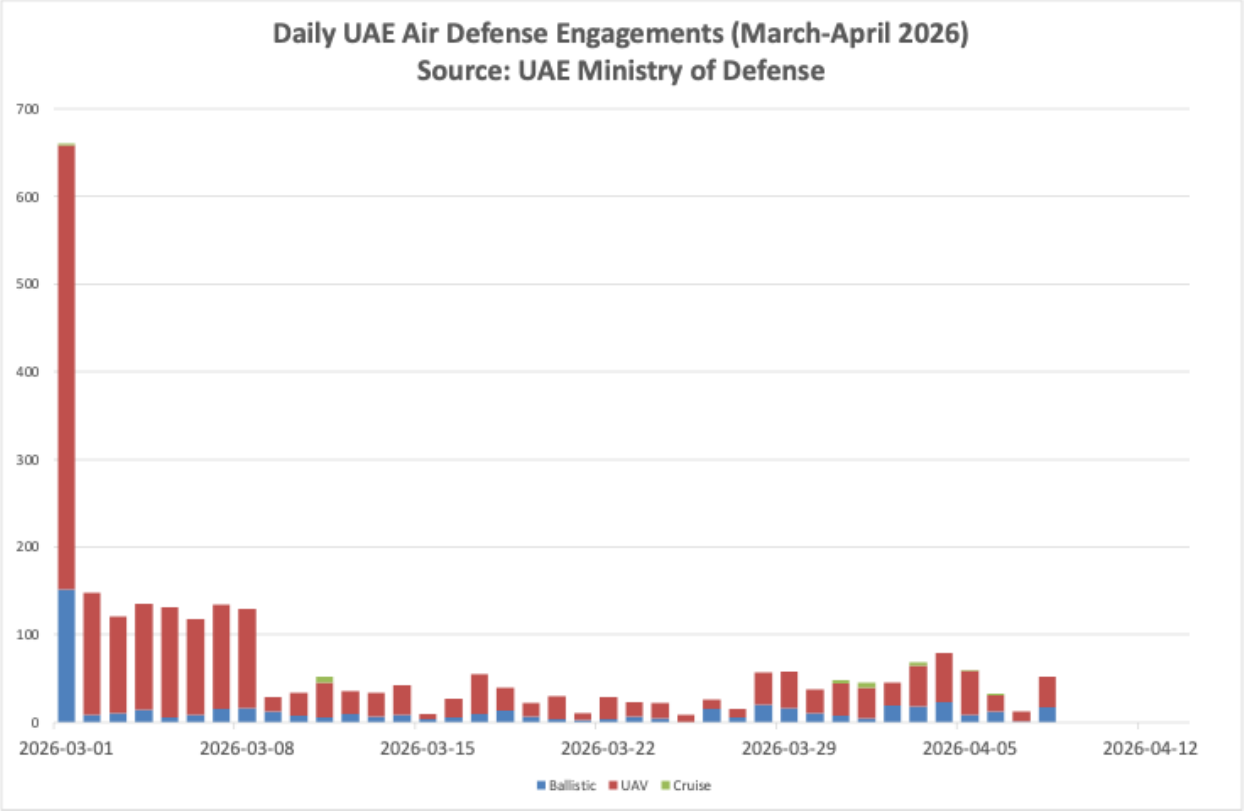
The graph tells a story in four movements. On the 28th of February, the campaign opened with approximately 150 ballistic missiles and 500 drones in a single day (data reported March 1st). That was the capacity demonstration: the attacker proving what it could deliver.
Within days, ballistic missile launches declined sharply and settled into a range of five to twenty per day. This is stockpile reality. Ballistic missiles are expensive, complex to produce, and every missile fired is one fewer in the arsenal. The stockpile defines the duration of the shock phase.
The drone launches stabilised at twenty to forty per day. That number has held for the duration. Drones are cheap, producible in volume, and replenished faster than they can be intercepted. The attacker’s production capacity defines the duration of the attrition phase.
The distinction matters. The missiles will eventually run out. The drones, absent a ceasefire, will not. What the graph shows through the first five weeks is not a declining campaign. It is a campaign that reached cruising speed.
From April 9, the volume drops to zero. This is the fourth movement, and it is the most important one analytically. The capacity was not exhausted. The stockpile was not empty. The drones did not stop because they ran out. They stopped because a choice was made. A ceasefire by choice is structurally different from a ceasefire by depletion: the capability remains intact, the threat remains resumable, and the uncertainty it produces does not disappear with the silence.
The defender does not pay per attack. The defender pays per defended day.
The Defender’s Dilemma #
As of mid-April 2026, the UAE Ministry of Defence reports cumulative interceptions exceeding 2,500 projectiles. The reporting is transparent, consistent and professional. It communicates competence to those who live inside the country and experience the defence system firsthand.
But it creates a dilemma that no communication strategy can resolve.
Read the same data through the eyes of a software engineer in Amsterdam, a finance director in Mumbai, or a physician in Cape Town who was considering a move to the UAE. What they read is not that the defence works. What they read is that thousands of projectiles were fired at this country in six weeks. And tomorrow there will be more. The Netherlands, among other countries, has placed the UAE on its highest travel advisory: essential travel only. That is not an assessment of the defence. It is an assessment of the threat.
Not reporting would be worse. An information vacuum fills with fear, rumour and the narratives of others. The UAE is right to be transparent about military engagements. But that same logic has not been applied to economic outflow, where the information gap is equally consequential and the private sector equally dependent on reliable data to plan.
This is the core formulation: the economic damage is not caused by the response, which is exemplary. It is caused by the existence of the threat itself. Even perfect interception does not change that.
There is a structural asymmetry in what is made visible. Military engagement data is published daily: projectile counts, interception rates, cumulative totals. Population outflow data is not. The private sector, which needs that information to make staffing decisions and long-term capital commitments, is left to infer from anecdote. The result is the same dynamic the government successfully avoids on the military side: an information vacuum that fills with speculation and the most alarming available signal. Managed transparency about economic outflow would not resolve the confidence problem. But it would replace noise with data, and give the private sector a basis for judgment rather than fear.
The safest day is the day the defence does not need to be activated.
This is why the UAE’s consistent diplomatic pursuit of de-escalation and ceasefire is not a concession. It is the logical consequence of this analysis. The only structural resolution to the confidence problem sits upstream: at the source of the threat, not in the response to it. The collapse of the Islamabad talks, and the US decision to impose a naval blockade rather than pursue further diplomacy, moves that resolution further away.
The Confidence Equation #
The damage transmits through behaviour, not through blast radius.
Expatriates who remain in the UAE shift from what might be called settlement mode to optionality mode. Settlement mode is the way most professionals live when they feel secure: long-term leases, children enrolled in local schools, investments in property, career commitments extending years into the future. Optionality mode is what replaces it when certainty erodes: shorter contracts, higher savings rates, deferred purchases, school applications filed in home countries as a contingency. The population is still physically present. But economically, it is partially disengaged.
The mechanism has accelerated. Schools across the UAE have closed physical campuses and moved to remote teaching. That single decision removed one of the strongest anchors binding professional families to the country. A child receiving online instruction can do so from Amsterdam as easily as from Abu Dhabi. The families have drawn the obvious conclusion. Flight activity data from the Flightradar24 Gulf Airline Recovery Index, combined with first-hand load factor observations during the conflict period, shows a persistent and severe asymmetry across the first six weeks: outbound flights departing near capacity, inbound flights returning partially empty1. The people who drive the UAE’s non-oil economy are leaving, and they are not coming back at the same rate.
Confidence among internationally mobile professionals does not travel through official communications. It travels through personal networks. A phone call from a friend in Abu Dhabi to a former colleague in Amsterdam, Mumbai or Cape Town carries more weight than any government statement. That network, which the UAE built over thirty years by offering a proposition that worked and letting the people who experienced it carry the message outward, now operates in reverse. Each conversation in which someone in the UAE cannot say with full conviction “yes, you should come” is a conversation that weakens inflow.
The economic damage is not a function of destruction. It is a function of three variables: the persistence of the threat, the mobility of the population, and the time over which both operate.
These three interact through a single transmission mechanism: confidence. When confidence declines, mobility, which in normal times is an economic asset, turns into a loss multiplier. And time, which in most economies allows recovery, turns into an irreversible force. In a highly mobile economy, time does not heal. Time locks in loss.
The Four Layers of Loss #
Conventional economic models measure damage through physical destruction and direct output loss. In the UAE, that approach captures only the surface. The damage operates across four layers, each compounding the one before it.
The first layer is consumption loss. Each professional household that departs removes a complete spending chain: rent, school fees, vehicle costs, hospitality, retail and services. Of the UAE’s roughly 11.5 million population, 88 per cent are expatriates; of those, an estimated 500,000 to 700,000 professional households earn above AED 350,000 annually. After remittances, local spending per household can be estimated at 55 to 70 per cent of gross income, per the Central Bank of the UAE.
Under a moderate scenario of 10 per cent household outflow over twelve months with a 15 per cent spending reduction among those who stay, the direct consumption loss runs into tens of billions of dirhams annually. With multiplier effects through real estate, retail and services, the total impact reaches the low hundreds of billions. Under a severe scenario of 25 per cent outflow with 25 per cent spending contraction, the impact approaches or exceeds the scale of the COVID-era contraction. The early indirect signals, drawn from aviation asymmetry and real estate repricing rather than population counts, are consistent with the severe scenario rather than the moderate one. They do not yet confirm it.
The real estate market confirms the direction. As of mid-April 2026, luxury property data across Abu Dhabi shows AED 232.5 million wiped across 643 listings, with the highest drop volumes concentrated in Yas Island, Saadiyat Island and Al Reem (152, 124 and 124 price cuts respectively), at average declines of 6 to 7 per cent. In Dubai, AED 882 million has been cut across 1,615 listings. These are asking prices. The transactional reality is worse: negotiated discounts, break clauses and flexible payment terms are now standard in markets where landlords set the terms twelve months ago. Transaction volumes are falling. Real estate agents are leaving. These are not indicators of a market correction. They are indicators of a market repricing the option to leave.
The COVID reference is analytically precise. The UAE’s GDP contracted 6.1 per cent in 2020. Consumer spending fell 14.3 per cent, approximately USD 24 billion in one year. But the structural difference is what matters. During COVID, the population stayed. Workers were furloughed, not departed. Recovery was rapid: GDP grew 3.9 per cent in 2021 and 7.9 per cent in 2022. During a conflict-driven outflow, the population leaves. That is the difference between a recession and structural erosion.
The second layer is governability erosion. Companies in the UAE that are 80 to 90 per cent staffed by expatriate professionals do not lose capacity linearly as people depart. They lose steering capability at a threshold. Expatriates occupy 89 per cent of all management positions in the country. Three senior departures within three months is not a capacity reduction. It is a phase transition. The organisation still functions but no longer steers. And the quality of execution across the economy is itself a confidence variable. When it declines, it reinforces outflow.
The third layer is replacement scarcity. The departed professional must be replaced from the same international pool that is draining. Singapore, Riyadh, Lisbon and a growing list of cities recruit from that pool with attractive packages and stable security perceptions. The replacement chain becomes a spiral: departure, vacancy, harder recruitment, higher cost, reduced attractiveness, and then even harder recruitment.
The fourth layer is pipeline loss. Young professional families are simultaneously the most mobile and the most risk-sensitive. Safety decisions about children are binary: good enough or not good enough. There is no gradual middle. Their departure carries the highest long-term cost, not because of their current spending but because of what they take with them: twenty years of future economic participation. With schools closed and remote teaching in place, the anchor that would have required their physical return has been removed.
Together, the four layers describe not a recession but structural erosion with compounding characteristics. The quantifiable consumption loss is comparable to or exceeds the COVID-era contraction. The non-quantifiable layers are larger in long-term impact and do not self-correct.
Why Recovery Is Not Automatic #
The conventional assumption is that conflict ends and the economy recovers. That assumption holds in economies where the labour force is bound to the land. The UAE has a fundamentally different structure. The production factor that carries the economy holds no citizenship, no land ownership rights, no family roots going back generations. Attachment is functional and transferable. Departure is fast and individual. Return is slow and conditional.
Every month a departed professional spends elsewhere deepens attachment to the new location: a child enrolled in school, a lease signed, a social network forming. The competition is not standing still. Riyadh, which emerged from this conflict with its infrastructure intact and its flights operating at near-normal capacity, is actively recruiting the professionals the UAE is losing.
The same logic applies to capital. The two destroyed AWS data centres can be physically rebuilt. But the decision to rebuild is a confidence question: does Amazon re-deploy capital here, or allocate to alternative locations where the risk profile is different? Capital, like talent, has options.
Every long-term plan the UAE has built shares one implicit assumption: that the operating environment remains stable and attractive enough to draw in international capital and talent continuously. Abu Dhabi 2030. The National AI Strategy 2031. The diversification away from oil. That assumption is no longer self-evident. The plans were not wrong. They were designed for a pre-conflict reality. The ambitions still hold. But the assumptions on which execution was built need recalibration. This is not a gap that can be addressed with a revision. It is a systemic shift: the premises on which the entire strategic architecture was built have changed simultaneously.
The collapse of the Islamabad talks and the imposition of a US naval blockade deepen this recalibration. The Strait of Hormuz, which carried a fifth of the world’s oil before 28 February, remains functionally closed. More than 200 loaded tankers are trapped inside the Gulf. The UAE’s oil exports are limited to the Habshan-Fujairah pipeline, which bypasses the Strait but operates at roughly half of pre-conflict export capacity. Higher oil prices partially compensate for the reduced volume, but they cannot compensate for the loss of the non-oil economy that the UAE spent thirty years building.
In most economies, time allows recovery. In a highly mobile economy, every month abroad is a month of roots planted elsewhere.
The Window #
The window in which recovery can be prepared is now, not after the conflict ends. Confidence must be maintained while the threat still exists. If it is not, the population and the capital the UAE needs for its post-conflict recovery will no longer be available when the threat passes. Every week that passes without active confidence maintenance narrows that window further.
Confidence travels through networks. The activation of the expatriate trust network is not a post-conflict strategy. It is a during-conflict necessity. The mechanism for doing so was described in the second essay in The 2026 Iran-War Series, The Network the UAE Already Has. The analysis in this essay provides the urgency for why it cannot wait.
One decision sits entirely within the government’s control and costs nothing to implement: publish the data the private sector cannot produce itself. Not to reassure, but to replace speculation with a verified baseline. The government has demonstrated that transparency about military engagements is manageable. A measured outflow is strategically manageable. An unmeasured one is not.
Assets can be rebuilt. A control point, once lost, must be rebuilt from scratch. The UAE’s most critical control point, the ability to attract the world’s professionals to build their lives here, took thirty years to build.
For boards operating in the UAE, the diagnostic has three implications in order of urgency. Which relationships and people, if lost in the next ninety days, cannot be recovered? Which strategic positions depend on assumptions about the operating environment that no longer hold? And what behavioural signals, not reported numbers, would tell you that the confidence equation is shifting, in either direction? These are not questions the data will answer. They require a different kind of instrument.
The most expensive consequence of this conflict is not what is leaving now. It is what will never arrive.
Further Reading #
This essay builds on and extends The 2026 Iran War Series, which examines the economic, strategic and behavioural dimensions of the conflict.
The Overlooked Risk Behind the Gulf Conflict (Essay 1) introduced expatriate confidence as the central economic variable this essay quantifies. outdoorconnect.ae/the-overlooked-risk-behind-the-gulf-conflict
The Network the UAE Already Has (Essay 2) proposed the mechanism for activating the expatriate trust network this analysis argues must be deployed during the conflict. outdoorconnect.ae/the-network-the-uae-already-has
When Strategies Fail (Essay 3) introduced the distinction between assets and control points that structures the analysis in this essay. outdoorconnect.ae/when-strategies-fail
The Art of the Deal (Essay 8) examined why the negotiation framework applied to this conflict was structurally incapable of producing agreement, providing context for the collapse of the Islamabad talks. outdoorconnect.ae/the-art-of-the-deal
The Last Check (Essay 9) followed the escalation logic to its boundary and argued that de-escalation is the only viable outcome still available. outdoorconnect.ae/the-last-check
The De-Escalation Paradox examined why ending the conflict may be structurally more difficult than sustaining it. outdoorconnect.ae/the-de-escalation-paradox
For the real-time assessment framework referenced in this series, see the US–Iran Escalation Risk Monitor. outdoorconnect.ae/us-iran-escalation-risk-monitor
For the strategic method underlying this analysis, see Strategy in Times of Systemic Shocks. outdoorconnect.ae/strategy-in-times-of-systemic-shocks
Notes
- A methodological note: seat capacity per carrier is estimated from fleet composition; load factors are inferred from observed flight volumes and first-hand travel observations, not publicly reported data. The inbound/outbound asymmetry is the core variable. Where load factors cannot be verified, conservative assumptions have been applied. The population outflow estimates derived from this data are order-of-magnitude bounds, not precise counts. The directional signal is robust; the exact magnitude is not. ↩
Cite this piece
Schotman, R. (2026). The Confidence Equation. Outdoor Connect. https://outdoorconnect.ae/library/the-confidence-equation/
© Outdoor Connect 2026. All rights reserved. Quote with attribution. Use and attribution